One idea can have more than one answer
A single artwork can feel complete on its own. Yet some ideas become more interesting when an artist returns to them. A series is a group of works connected by a subject, question, process, or visual choice. The connection might be obvious, as in several paintings of the same room, or subtle, as in drawings that share a particular rhythm of lines.
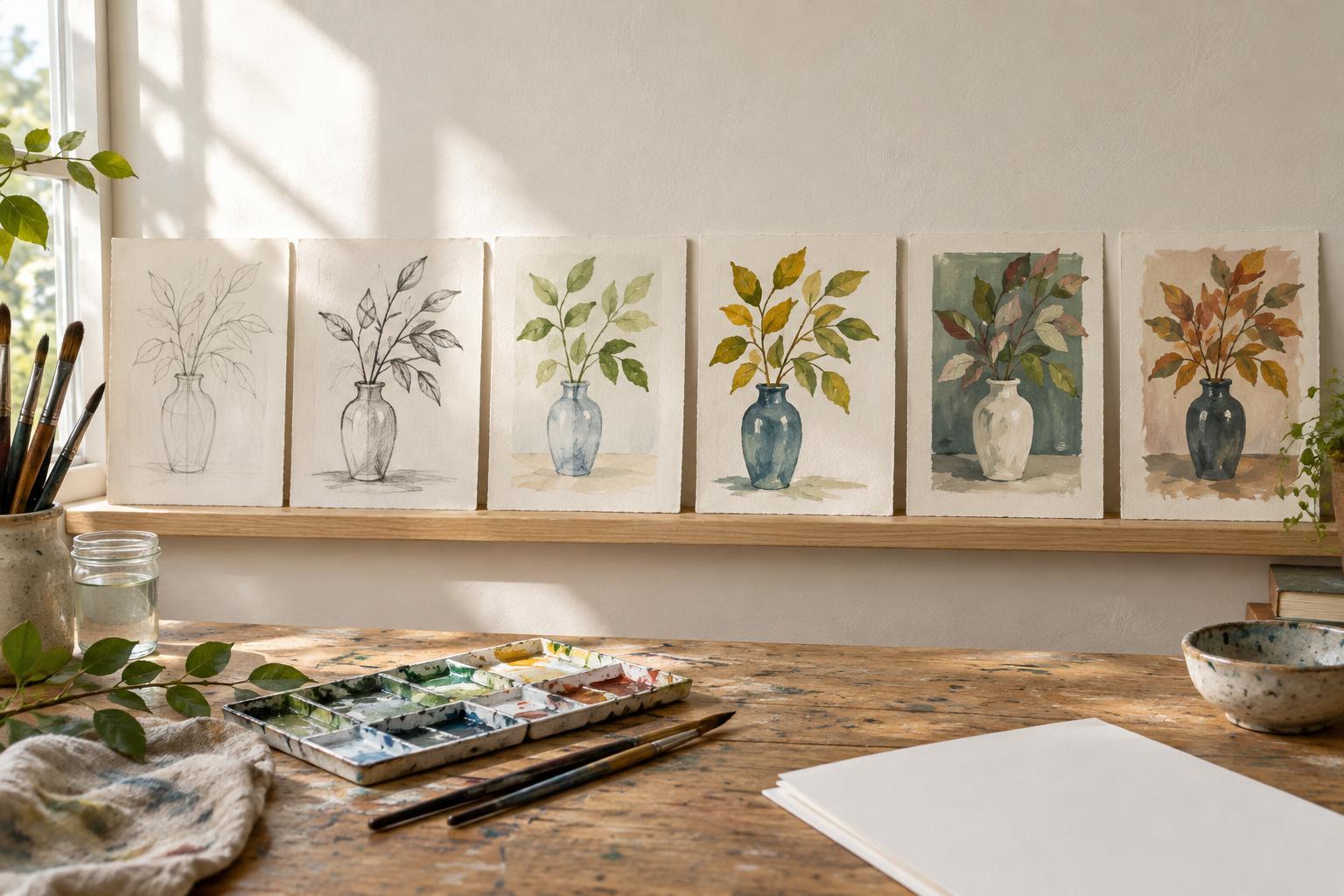
Working in a series lets an artist ask, “What else could this become?” The first piece might show a subject in bright color, while the next uses a narrow range of tones. Neither has to replace the other. Together, they make the artist’s choices easier to notice. A series offers space to explore possibilities rather than settle on one definitive version.
Repetition makes differences visible
Repeating a subject can sound restrictive, but a familiar starting point makes small changes stand out. Imagine several images of a chair. A shift in viewpoint can make it seem sturdy or precarious; a change in scale can make it feel intimate or imposing. Because the object stays recognizable, viewers can pay closer attention to composition, light, texture, and mood.
Artists may also use repetition to understand how a material behaves. Making several prints from a related set of shapes, for example, can reveal how different arrangements affect balance. A series does not need to follow a rigid plan. One attempt may suggest the next, allowing a question about color to turn into a question about space.
A series can show change over time
Some subjects cannot be captured fully in a single moment. A garden changes with the seasons; a street looks different as the light moves; a familiar face can carry many expressions. Related works allow an artist to attend to these shifts without forcing them into one crowded image. The pieces may record observations, but they can also show changing impressions of the same place or person.
Change can happen in the artist’s approach, too. Early works in a series might be careful and descriptive, while later ones become looser or more abstract. That progression need not tell a simple story of improvement. It can show an artist becoming curious about different qualities of the subject. Seeing the works together makes that movement part of the experience.
Connections give individual works new meaning
A series can create a visual conversation. One work may introduce a shape, another repeat it in an unexpected setting, and a third leave it out. Placed side by side, the pieces invite comparisons that would be difficult to make if each were viewed alone. Their order can matter, but there is not always a single correct way to read them.
This does not mean every piece in a series must look alike. Artists can hold one element steady while changing others, or bring together works that share a question rather than a style. A group of images about home, for instance, might include interiors, objects, and empty thresholds. The link is the idea being explored, not necessarily a repeated picture.
How to look at a series
When you encounter related artworks, start by giving each piece a moment of its own. Then step back, if the setting allows, and look for what carries across the group. Is it a color, a viewpoint, a material, or a feeling? Notice where the pattern breaks. An exception can be as revealing as a repeated feature because it changes what you expect from the next work.
You can try the same approach while making art. Choose an ordinary subject, such as a cup or a view from a window, and make three versions while changing just one feature each time. The exercise is not about producing a matching set. It is a way to see how many choices sit inside a seemingly simple image—and why an artist might want more than one artwork to explore them.