An artwork that happens in time
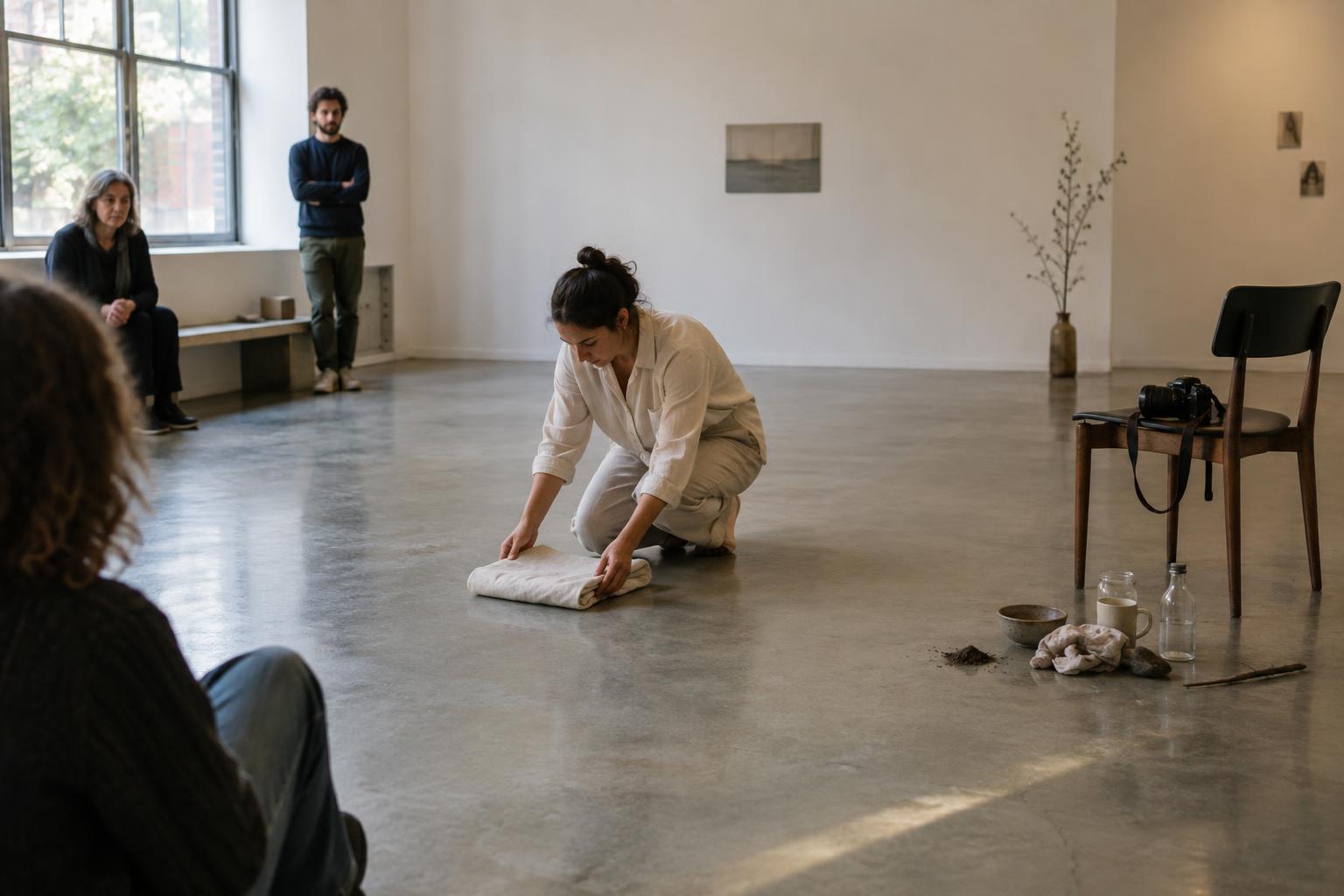
A performance artwork takes shape through an action or series of actions. An artist might walk a repeated route, arrange objects, speak, remain still, invite participation or carry out a task in public. The work may last minutes or hours. Its materials can include a body, a room, a set of instructions and the attention of people nearby. Rather than asking only what an artwork looks like, performance art invites us to notice what happens and how it changes over time.
Performance art can overlap with theater, dance, music and everyday ritual, but it does not need a stage, a character or a conventional story. Some works are carefully planned; others leave room for chance or audience response. A simple action can feel different depending on where it occurs, who encounters it and how long it continues. Those conditions are part of the work, not just its backdrop.
What an audience brings to the work
Watching a performance is an active form of looking. You may notice a gesture first, then the effort behind it, then the reactions of other people. A pause that might seem insignificant in a photograph can feel long when you experience it alongside the performer. Even if viewers do not take part directly, their attention may affect the atmosphere. In some works, the artist explicitly makes that relationship between performer and audience the subject.
You do not need to decode a performance immediately. Start with observations: What is repeated? What changes? How does the space shape what you can see or hear? If participation is invited, pay attention to its boundaries and remember that an invitation is not an obligation. When a work takes place in a shared space, it is also worth considering how it affects people who did not arrive expecting to see art.
The difference between an event and its record
Once a performance ends, a photograph or video may be the easiest way to encounter it. A record can show the setting, reveal details you missed and allow others to learn about a work they could not attend. Written descriptions, sketches, sound recordings and accounts from witnesses offer other perspectives. None is a neutral container for the whole event: a camera selects a viewpoint, while a witness remembers through their own experience.
This does not make documentation a lesser form of looking. It asks us to be precise about what we are seeing. A photograph might be part of a work planned for the camera, or it might be a later record of an event whose central experience was live. An image of a crowded room tells us something different from a participant’s account of standing in it. Looking across several kinds of record can make those differences more visible.
Objects, instructions and memories that remain
A performance may leave physical traces: moved furniture, worn materials, a drawing made during the action or an object given to a participant. These can help tell the story of what happened. Yet a leftover object is not automatically the artwork’s most important part. Its meaning may depend on the action that produced it, and an apparently ordinary item can carry a strong association for someone who was present.
Some artists use written instructions, sometimes called scores, to set out actions that others can perform. A work based on a score might be enacted again, but each occasion will have its own people, place and timing. Memories travel differently. Two witnesses may recall the same event in contrasting ways, and both accounts can illuminate it. What remains, then, may be less like a single preserved object than a collection of related traces.
How to approach a performance you did not see
If you encounter a performance through an exhibition, book or screen, begin by identifying what you have in front of you. Is it a recording of the full event, a short excerpt, an artist’s instruction, an object used in the action or a new work made from earlier material? Read any available description for basic context, such as the location and the role of the audience. Then ask what the document makes clear and what it cannot convey.
Performance art makes a familiar question unusually vivid: where does an artwork end? The live action stops, but its effects can continue in conversations, records, objects and future performances. Those remains do not need to recreate the original moment perfectly to matter. They offer ways to think about it while leaving space for what could only have been experienced there and then.