Start with what happens after the ink dries
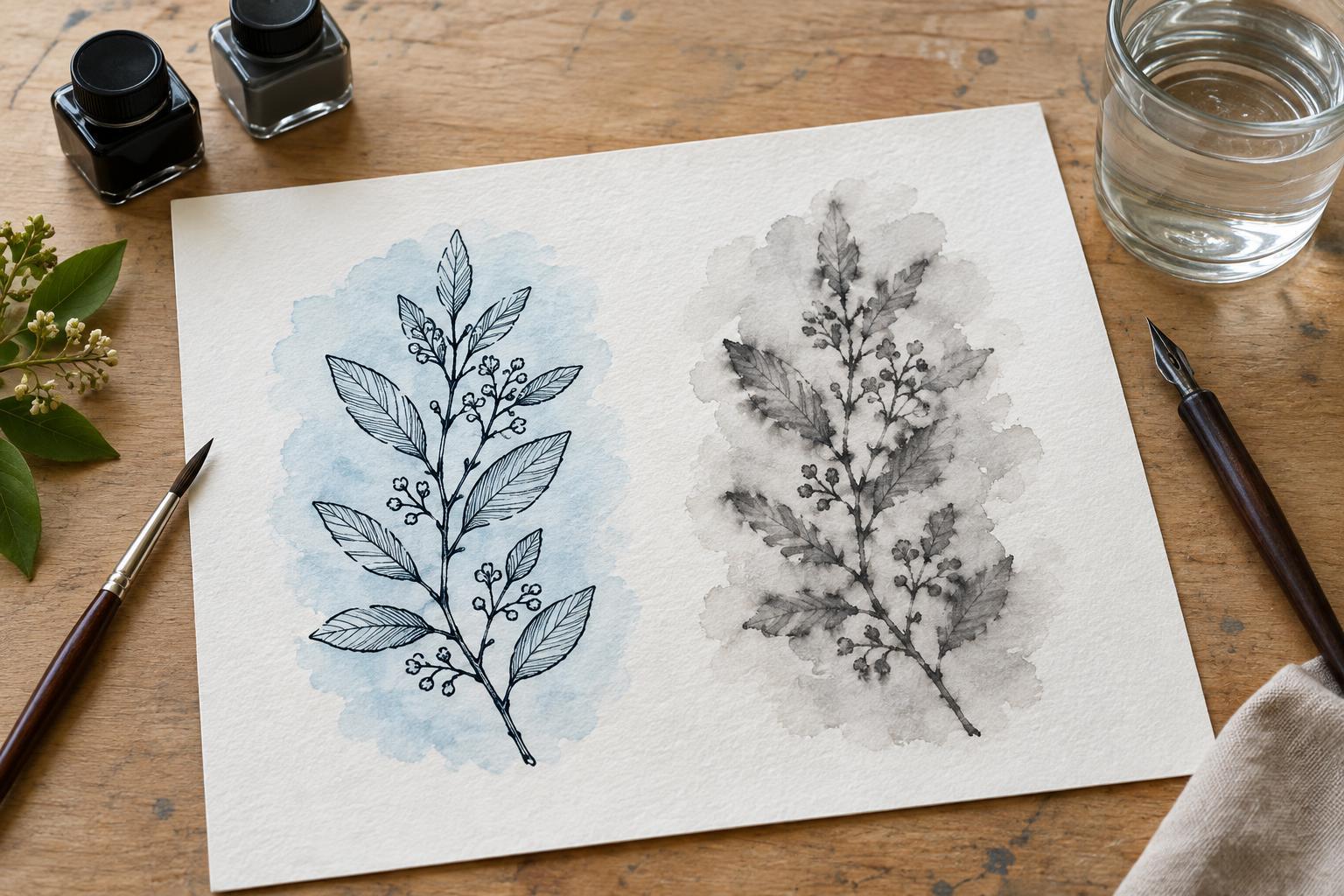
Drawing inks can look similar in the bottle but behave differently once they reach the page. A waterproof ink is intended to resist water after it has dried. That makes it a useful choice when you want to draw crisp lines first and add a watercolor wash later. A water-soluble ink can move again when you touch it with a damp brush. That movement might be an unwanted smudge, or it might be the effect you are looking for.
The labels are helpful, but they are not a complete description of an ink. Some inks resist a light wash yet soften with repeated brushing; others need more drying time than you expect. Color, paper, and the amount of water can change the result. Before using a new ink in a finished drawing, make a few lines on a scrap of the same paper, let them dry, and brush clean water across them. This small test tells you more about your particular combination of materials than the label alone.
Choose waterproof ink for lines that should stay put
Waterproof ink suits techniques in which the drawing acts as a stable framework. You can outline a building, plant, or still life, allow the lines to dry, and paint over them without deliberately blending the ink into the color. It can also help when you want to work in layers: inked details remain more distinct while you add transparent washes or damp brushwork nearby.
Waterproof does not mean indestructible. A line may still lift if it has not dried fully, if the paper surface is disturbed, or if it is scrubbed repeatedly. Paper matters here: a smooth, sturdy sheet can make fine pen lines easier to control, while a paper intended for wet media is generally better prepared to handle generous washes. If you plan to use a lot of water, test both the ink’s resistance and how the paper responds.
Choose water-soluble ink when movement is part of the drawing
Water-soluble ink lets you turn a drawn mark into a wash. Draw a few lines, then pull pigment outward with a damp brush to create soft shadows, atmospheric edges, or a range of tones from one pen. You can leave some marks dry and sharp while loosening others. This approach works well for quick sketches when you want line and shading to feel connected rather than carefully separated.
The amount of water gives you some control, but it also introduces surprises. A barely damp brush may soften an edge; a wetter brush can carry color farther across the page. Try moving water from the edge of a line into a blank area rather than brushing back and forth over the whole mark. Let one wash settle before adding another if you want to preserve lighter areas. When a clean boundary is essential, keep the soluble ink away from later wet layers or choose a different ink for that part of the drawing.
Match the ink to the tool, not just the image
Think about how you will apply the ink. Dip pens and brushes can accommodate inks that are unsuitable for a fountain pen, while fountain pens require ink specifically made for their feed systems. Inks that form a durable film or contain ingredients that can collect inside a pen may be difficult to clean out. Do not assume that an ink labeled “drawing ink” is fountain-pen safe; check the manufacturer’s guidance for the particular bottle and tool.
Water resistance and tool compatibility are separate questions. A water-soluble fountain-pen ink may be convenient for portable sketching, while a waterproof ink applied with a dip pen may be better for a drawing that will receive a wash. Clean tools according to the ink’s directions, especially after using a waterproof formula. A simple setup—one ink, a suitable pen or brush, and paper you know—often makes it easier to understand what each mark is doing.
Build a quick test into your creative process
Make a small reference sheet when you try an ink. Draw thin lines, heavy strokes, and a filled shape; note which tool made each mark. Once they are dry, leave one group untouched and pass a damp brush over another. Add a second pass of water to see whether the result changes. If you often combine ink with watercolor, colored pencil, or another medium, test that sequence too.
For a practical decision, ask what you want the water to do. If it should color the spaces around your drawing without shifting the lines, begin with a waterproof ink and confirm that it has dried. If it should help make the shadows and transitions, begin with a water-soluble ink. Neither type is inherently more expressive: the useful choice is the one that supports the marks you want to keep and the marks you want to move.