What is closure?
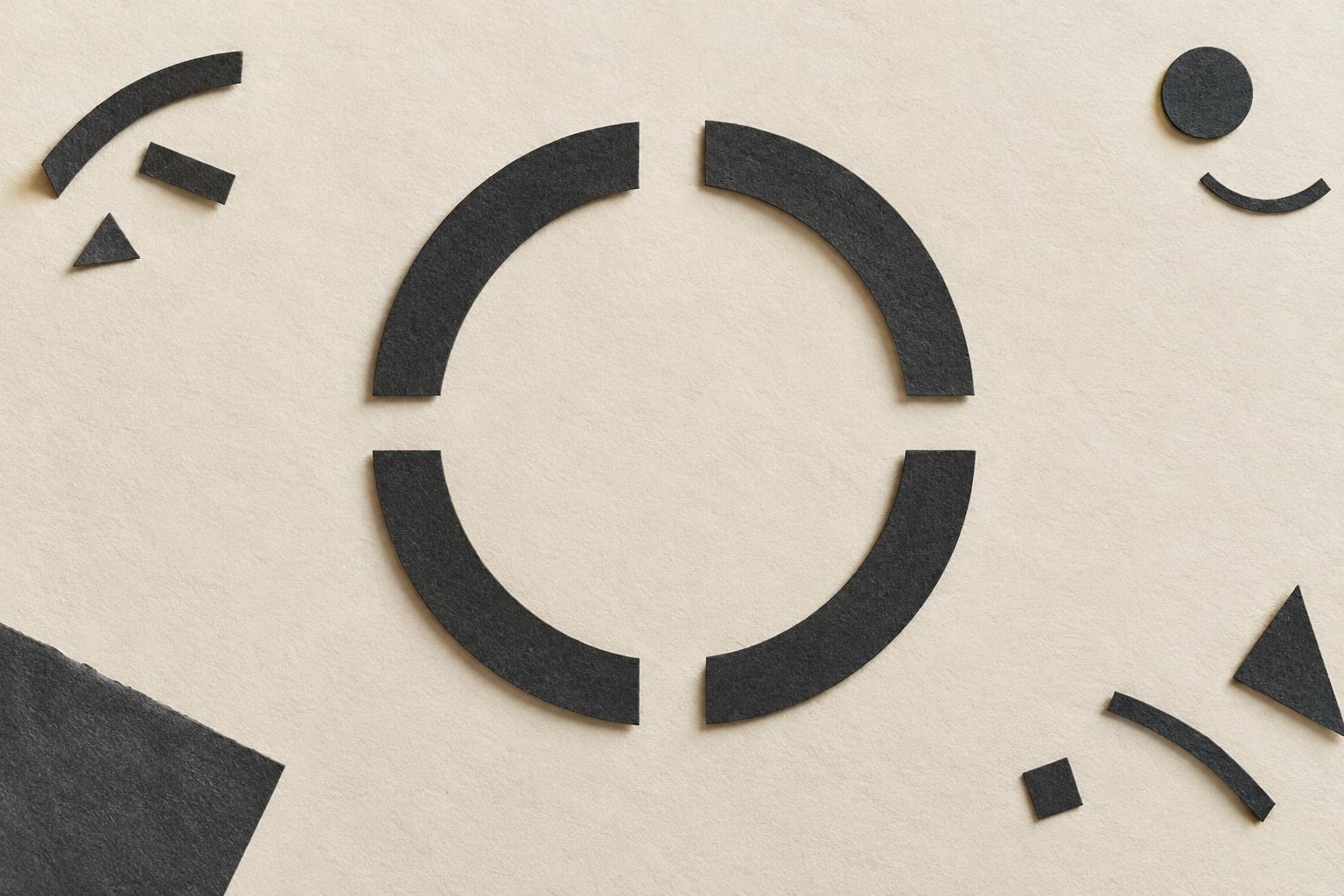
Imagine a circle drawn with several small gaps. You can probably recognize it immediately, even though no continuous line encloses the space. The Gestalt principle of closure describes this tendency to perceive a whole shape when enough of its parts suggest one. Instead of attending only to each separate mark, we also make sense of how the marks relate.
Closure is a useful way to describe an experience, not a rule that every viewer will see the same thing. The size and placement of the gaps matter, as do contrast and the surrounding image. A familiar outline may be easy to recognize from a few fragments; an unfamiliar shape may need much more information. The principle helps explain why an incomplete drawing can feel finished without pretending that the missing lines are actually on the page.
How the eye finds the missing shape
A viewer encounters edges, curves, corners and spaces between marks. When those pieces appear to belong to one boundary, the viewer may perceive the boundary as continuing through the gaps. Four separate corner marks, for example, can suggest a rectangle if their positions and angles line up. Move one corner far away or rotate it, and the rectangle may become harder to see.
Closure often works alongside other ways we organize what we see. Marks placed near one another may seem related; edges pointing in compatible directions may seem to continue; a figure with strong contrast against its background may be easier to distinguish. Negative space matters too. The blank area inside a suggested shape can help define it, even when much of its outline is absent. These relationships explain why simply removing parts of a drawing does not automatically make an effective use of closure.
Where closure appears in art and design
In an illustration, a figure might emerge from a few well-placed lines rather than a complete contour. A shoulder can be suggested by the end of one stroke and the beginning of another, leaving the viewer to connect them. This can make an image feel light and open, particularly when the unmarked paper becomes part of the composition. In a painting, adjacent areas of color can similarly suggest an object without outlining every edge.
Closure can also shape a logo, poster or page layout. An interrupted outline may invite a moment of recognition, while repeated elements can imply a larger form that is never drawn. For instance, several short arcs arranged around an empty center might read as a ring. The effect is most useful when recognizing the whole supports the message. If a sign or instruction must be understood at a glance, an overly ambiguous shape can work against its purpose.
How to use closure deliberately
Start with a simple, recognizable shape, such as a leaf, cup or square. Draw its complete outline, then remove one short section. Keep removing or shifting sections and notice when the shape becomes difficult to recognize. This gives you a practical way to test how much information the image needs. Try changing only one thing at a time: gap size, line weight, contrast or the position of the remaining marks.
Pay attention to where the breaks occur. A gap in a long, predictable curve may be easier to bridge than a gap at a distinctive corner. You can preserve an important feature while leaving a less informative edge open. Also check the shape at the size and distance where someone will encounter it. A delicate arrangement that reads clearly on a large page may become a cluster of unrelated marks when reduced.
Finally, ask what the open area contributes. Does it create breathing room, draw attention to a focal point or allow another element to overlap? Leaving a line out is not always an improvement. The strongest choice is the one that helps the viewer understand and enjoy the composition, whether the outline is complete or not.
A small exercise in looking
Choose a printed image, a drawing or an object in your room and look for places where you perceive an edge that is not visibly marked. You might notice a pale object blending into a pale background, yet still read it as a distinct form because other edges give you enough clues. Trace the visible parts with your gaze, then identify the section your perception seems to supply.
Next, sketch the same object using only a few separated marks. Show it to someone without naming it and ask what they see. If their reading differs from yours, look together at which gaps invite connection and which create uncertainty. Closure is not a trick with one correct outcome; it is a practical reminder that viewers bring the parts of an image together. Understanding that contribution can help you make more considered choices about what to draw, what to leave open and where to let empty space do some of the work.