Give the artwork a place to be seen
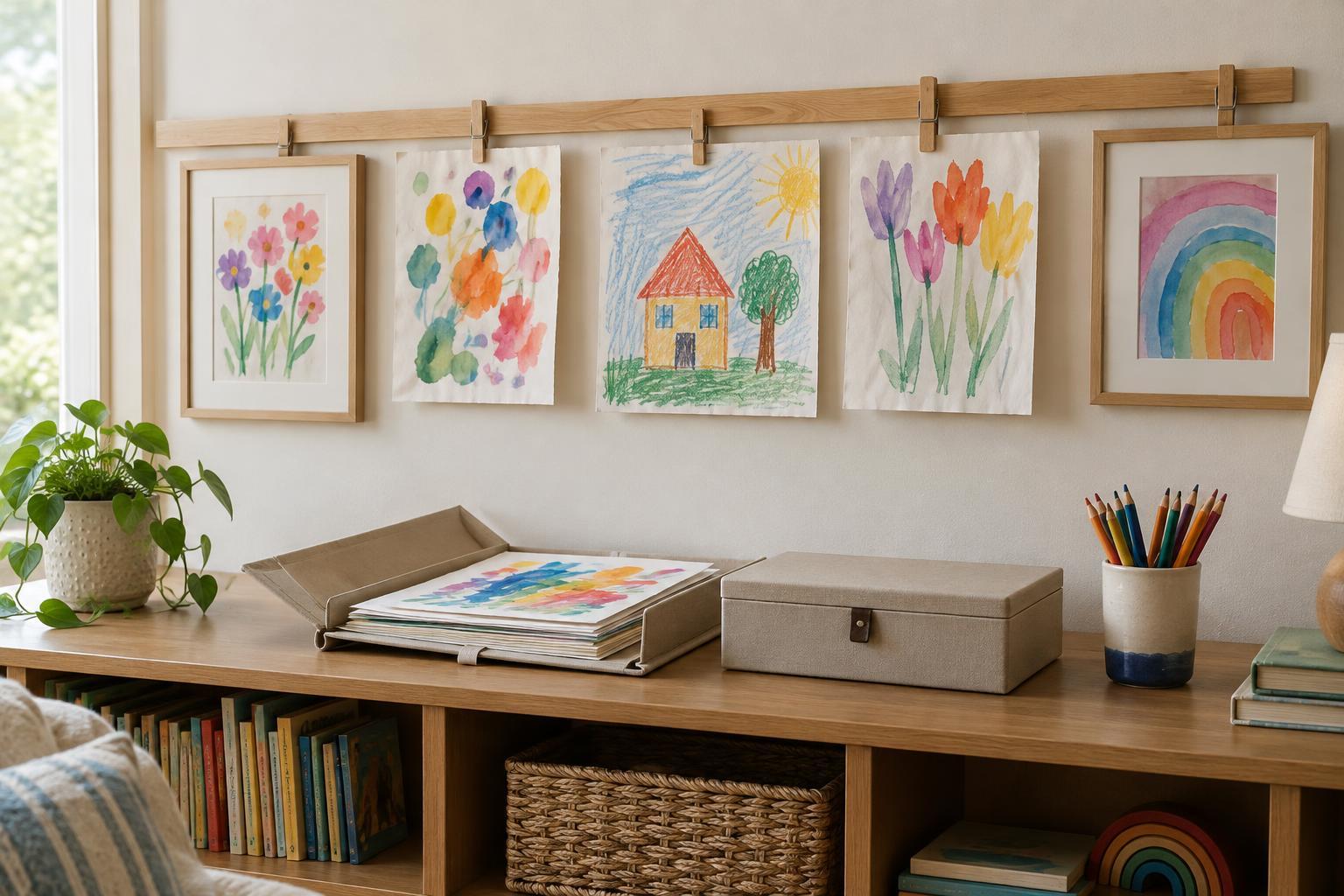
A dedicated display spot lets children’s artwork become part of a room rather than something temporarily attached to every available surface. Choose a place you pass often: a hallway, the side of a bookshelf, or a wall near the kitchen table. It does not need to be large. A narrow row of pictures can feel more deliberate than a crowded wall, especially if you leave a little space between pieces.
Match the display method to the work and the room. A few lightweight frames suit flat drawings; a picture ledge allows you to change what is shown without rehanging everything. Clips on a rail or string can hold pieces in different sizes, provided they are secured well and kept away from small children who might pull them down. For thick paintings or collages, a shelf may be kinder to the artwork than clips that squeeze its edges.
Make changing the display easy
A display works best when it is simple to refresh. Keep a small stack of recent work nearby and swap in a piece whenever your child wants to show something new. You can let them choose one favorite for a shared space and another for their own room. This gives them a say without requiring every drawing to stay on view indefinitely.
There is no need to treat the rotation like a formal exhibition. A drawing might stay up for a week, while a beloved painting remains for months. When a piece comes down, decide whether it belongs in storage, can be reused for a craft project, or can be let go. Taking a moment to notice what your child enjoyed making may matter more than finding a permanent place for the finished work.
Use simple choices to create a pleasing display
Children’s art often brings its own lively mix of color and scale. To help several pieces sit comfortably together, look for one unifying element. Similar frames can make very different drawings feel like a group. Alternatively, use clips of the same style and let the artwork vary. A small collection arranged in a loose grid can look calm, while a single large painting can stand on its own.
Consider the background, too. Bright work may be easier to appreciate against a plain wall or a simple mat inside a frame. If you frame an original, make sure it is dry and can be removed later without damage; avoid taping it directly to the glass. Sunlight can fade some colors over time, so choose a spot out of strong direct light for pieces you especially want to keep.
Store the keepers without creating a mystery pile
For work you want to save, start with one container that fits the sizes your child usually makes. A portfolio folder works well for flat pages; a sturdy box can hold irregular pieces, small sculptures, and collages. Let paint and glue dry completely before putting anything away. Store flat work without tightly folding or rolling it, and avoid piling heavy objects on top of delicate materials.
A simple label can make a collection much more meaningful later. Write the child’s name, an approximate age or school year, and perhaps a few words about the picture on a separate sheet or the back of a sturdy piece. If you want to protect fragile work, slip it into a sleeve or place a clean sheet of paper between pieces. You do not need specialist supplies for every drawing; the aim is to keep the collection dry, organized, and easy to revisit.
Keep the memories, not necessarily every sheet
The volume of artwork can grow quickly, and keeping everything may make it harder to find the pieces you love. Choose a few that show a new idea, a favorite subject, an unusual technique, or a moment your child remembers clearly. If a picture is too large or fragile to store, photograph it in even light before deciding what to do with the original. A photo can also help you remember a temporary display or a three-dimensional project.
Sorting is easier when it feels respectful rather than secretive. Invite your child to pick favorites when they are interested, but allow room for their choices to change. Some pieces can be displayed, some saved, and some enjoyed for a while before being recycled where local rules allow. The goal is not a perfect archive. It is a manageable collection that leaves space for the next drawing to arrive.