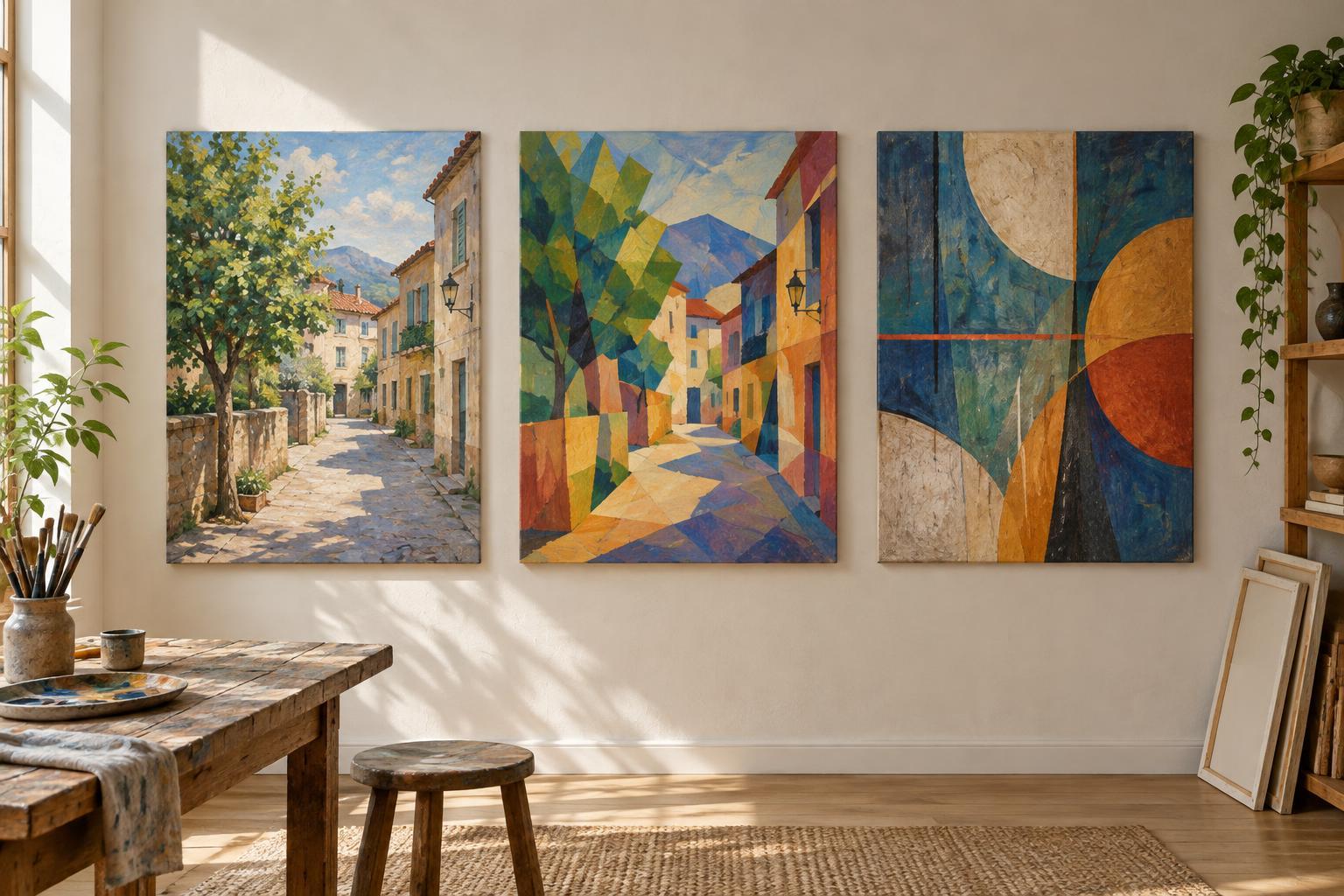
Three ways an artwork can relate to the visible world
The distinction between representational, abstract, and nonobjective art begins with a question: does the artwork depict something we could recognize outside the artwork? A portrait that shows a face is representational. A portrait that reduces the face to a few altered planes is abstract. A composition of shapes that is not intended to depict a face, landscape, or other recognizable subject is nonobjective.
These terms describe an artwork’s relationship to recognizable subjects, not its quality, difficulty, or emotional effect. They are also useful descriptions rather than rigid boxes. An artist can combine recognizable and invented elements in one work, and viewers may disagree about whether a shape suggests an object. Looking closely at what the work shows—and what it leaves open—is more helpful than rushing to assign a label.
Representational art: a subject you can identify
Representational art depicts people, places, objects, or scenes that viewers can generally identify. A drawing of a bicycle, a painting of a kitchen, and a sculpture of a bird all fit, even if their subjects are stylized. Recognition, rather than photographic accuracy, is the key. A loosely painted bowl of fruit remains representational if you can tell that it is fruit in a bowl.
Representational artists make choices about what to emphasize. A portrait might exaggerate a gesture or simplify the background to focus attention on the sitter. A landscape might rearrange colors while keeping a clear sense of hills and sky. The work does not have to copy appearances exactly; it gives viewers enough visual clues to connect its forms with things in the world.
When looking at representational work, notice how that connection is built. Which details establish the subject? What has been omitted or changed? The answers can reveal an artist’s priorities just as clearly as the subject itself.
Abstract art: a recognizable starting point transformed
Abstract art changes or simplifies a subject instead of presenting it straightforwardly. Imagine drawing a tree, then emphasizing the rhythm of its branches over the texture of its bark. Push that process further, and the tree might become a network of lines and colored areas. It may still be possible to sense the original subject, even when the image no longer resembles a conventional tree drawing.
Abstraction can take many forms. An artist might flatten depth, shift colors, repeat a shape, break an object into fragments, or remove details. Some abstract works retain clear clues to their subjects; others leave only a faint connection. That range helps explain why one viewer may see buildings in a composition while another sees chiefly an arrangement of rectangles.
It can be useful to ask what has changed, rather than only what the image is “of.” A distorted chair, for example, might direct your attention to its angles, its place in a room, or the feeling of sitting there. Abstraction gives those choices room to become the main event.
Nonobjective art: no depicted subject is required
Nonobjective art is not organized around depicting a recognizable person, place, or object. Its subject may be the relationship among lines, shapes, colors, textures, and space. Consider a composition made of overlapping circles and bands of color without an intended reference to planets, flowers, or any other identifiable thing. You can attend to how the forms balance, clash, repeat, or draw your eye across the surface.
This does not mean nonobjective art is random or empty of meaning. Choices about scale, spacing, edges, materials, and color can create tension, calm, movement, or surprise. Nor does it mean viewers must stop making associations. You might see a horizon in a horizontal line, even if the work does not depict a landscape. Your association is a way into the experience; it does not necessarily establish what the artwork represents.
The boundary with abstract art can be hard to locate from appearance alone. A cluster of shapes could be a heavily simplified still life or a composition without an external subject. If the artist’s starting point is unknown, it is reasonable to describe what you see without insisting on a definitive category.
How to use the distinctions when you look
Try approaching an unfamiliar artwork in two passes. First, name what is visibly present: a figure, perhaps, or a group of curved marks against a pale field. Then ask whether those elements depict a recognizable subject, transform one, or seem to work without one. This keeps the question grounded in the artwork rather than in a guess about what you are supposed to see.
Next, follow your attention. In a representational work, you might move from the subject to the choices that shape it. In an abstract work, you might trace which familiar clues remain and which have been altered. In a nonobjective work, you might notice a repeated color, an uneven interval, or the contrast between smooth and rough areas.
The categories are starting points for looking, not tests to pass. A work can sit between them, and you can enjoy its composition before you settle on a name for its approach. What matters most is noticing how its visible elements invite you to look.