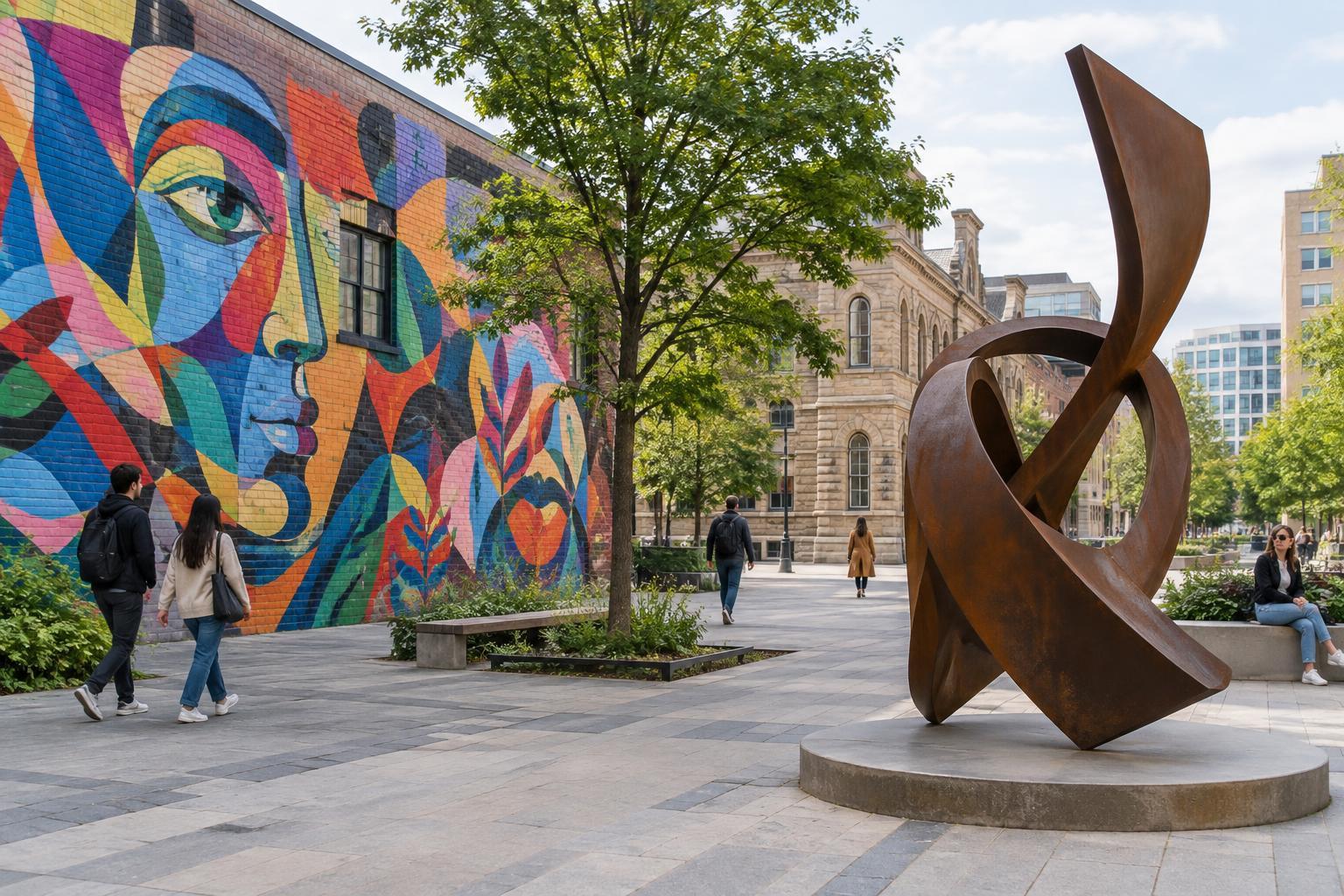
Art beyond the gallery
A painted wall can make a familiar walk feel new. So can a sculpture beside a bus stop or a pattern set into a pavement. These works share an important feature: people encounter them while going about their day, often without planning to look at art. That shared setting is one reason public art and street art are easy to confuse.
Public art is a broad term for work made for spaces people can access. It might be a sculpture, mural, memorial, light installation or design integrated into a building. Street art usually refers to visual work made on surfaces in the urban environment, especially walls, shutters and other structures. Neither term describes a single style. A brightly painted mural may belong to both categories, while a sculpture in a park and a small stencil on a doorway may have little in common beyond their outdoor setting.
Who plans the work, and who gives permission?
One useful distinction is how a work comes into being. Public art is often commissioned or formally approved by a local authority, property owner, community group or other organizer. The artist may respond to a brief, discuss a location with residents and plan for installation and upkeep. These steps can shape the size, materials and subject of the finished piece.
Street art may be self-initiated instead. An artist might choose a surface because of its texture, visibility or relationship to the surrounding streets. Some street art is made without the property owner’s permission; other work is invited, commissioned or created in designated spaces. Permission, then, is a helpful question but not a complete definition. An approved mural can retain the visual language and quick impact associated with street art.
These differences affect how a work is received. A planned installation may arrive with a title or an explanation nearby. A street piece may leave viewers to work out its meaning from the image and its setting. Neither approach guarantees a stronger connection with the public: the work’s placement and the viewer’s own experience matter too.
Materials, scale and lifespan
Public art often needs to withstand weather, touch and repeated use of its surroundings. Artists may choose stone, metal, tile, durable paint or other materials suited to a particular site. Some works are intended to remain for many years; others are temporary by design. Even a permanent work changes as plants grow around it, buildings alter and people find new ways to use the space.
Street art commonly uses spray paint, brushwork, paste-ups, stickers or stencils, though the possibilities are wider than any list of tools. A piece may be covered, removed, weathered or painted over. That uncertain lifespan can be part of how it is understood: a viewer sees not just an image but a moment in a changing surface. A commissioned wall painting can also fade or disappear, so durability is another tendency rather than a firm boundary.
Scale changes the encounter as well. A large work may be visible from across a square and help define its character. A small image near eye level may reward someone who slows down. Both can draw attention to details of a place that passers-by might otherwise miss.
How the setting becomes part of the artwork
Outside a gallery, an artwork rarely has the space to itself. Traffic, shop signs, trees, architecture and daily activity all enter the picture. A public artwork might frame a route through a park or give people a place to gather. Street art might respond to the shape of a doorway, the color of a wall or the messages already visible nearby. In each case, moving the work somewhere else could change its effect.
The relationship between a work and its audience can differ, too. A memorial may invite reflection, a playful installation may welcome interaction, and a painted character may catch someone’s attention for only a few seconds. It is worth avoiding simple assumptions about whose voice either category represents. A commissioned work can grow from close community involvement, while a self-initiated piece may express one person’s view. Looking at the specific work and its context tells us more than its label alone.
A simple way to look more closely
Next time you notice art outdoors, begin with what you can see. Where has it been placed, and what can you see from different distances? Does it seem designed for a slow visit or a passing glance? Notice how its color, shape and scale relate to the buildings or open space around it. If information about its maker or purpose is available nearby, consider how that changes your first impression.
Then ask questions that may not have obvious answers: Who might use this space? Does the work invite people in, interrupt their routine or prompt disagreement? Would its meaning change if it were removed from this location? Public art and street art overlap because both make visual expression part of shared space. Their differences in planning, permission and lifespan offer more ways to look, rather than a rule for deciding which deserves attention.