A viewpoint is more than a place to stand
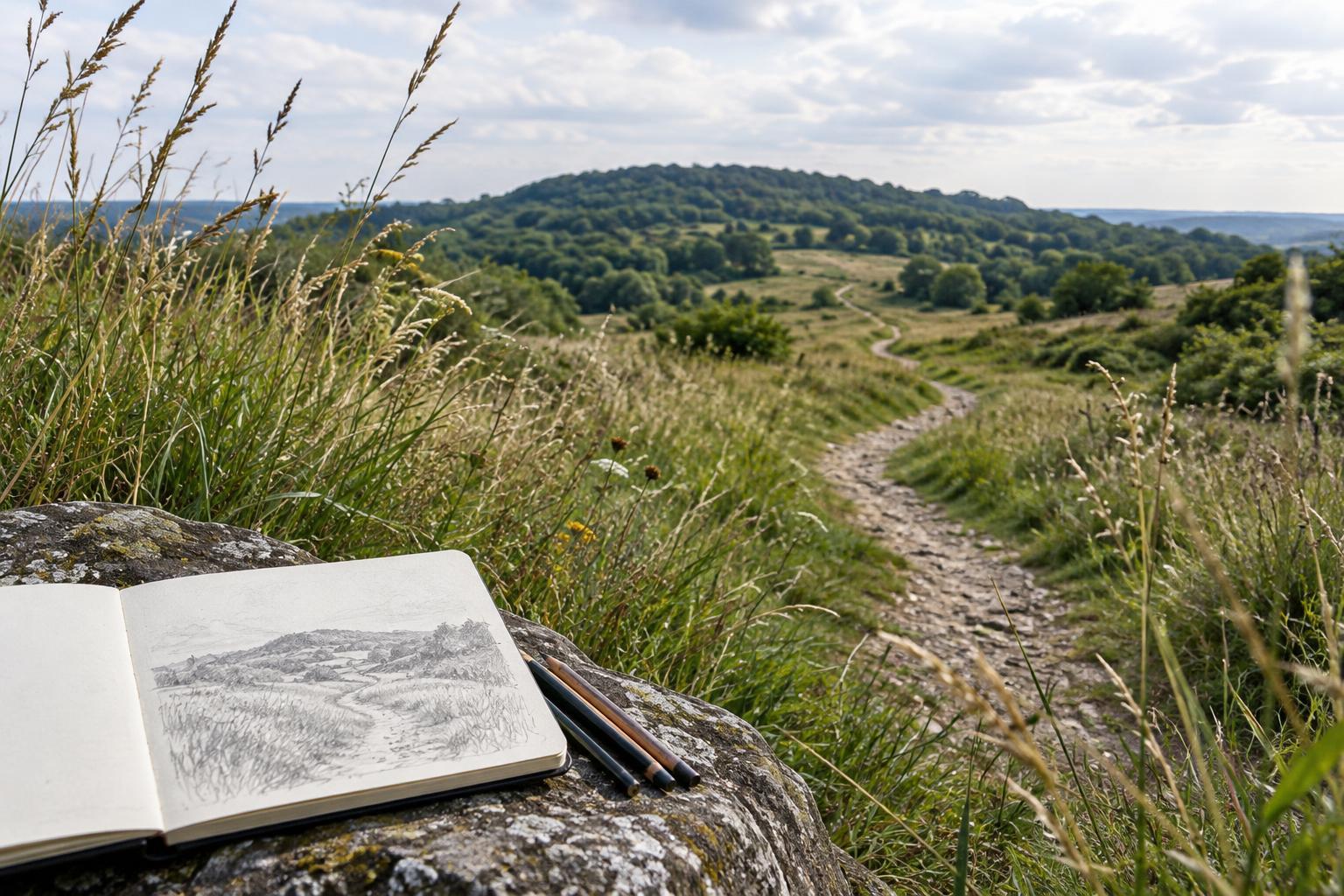
Imagine a path crossing a field toward a line of trees. From the path, the trees may appear to close around you. From a nearby rise, the same path becomes a shape that divides the field. Neither view is more truthful: each reveals some features and conceals others. Landscape artists choose a viewpoint to decide what the viewer will notice first and how it might feel to move through the place.
That choice includes more than location. Eye height, direction, distance, and the width of the scene all matter. An artist can stand still and make several different pictures simply by turning, looking up, or cropping the view. When comparing landscapes of one place, ask where the artist seems to be and what lies outside the frame.
Eye level changes the relationship between land and sky
A low viewpoint can make grasses, stones, or a riverbank loom large. Distant hills may rise behind them, giving the scene a sense of depth and inviting viewers to imagine themselves close to the ground. If a person or tree is seen from below, it may appear especially tall. This does not require exaggerating its size; the angle does much of the work.
From a higher position, an artist can show how fields, roads, and waterways connect. Patterns that are hard to see at ground level become easier to read. The horizon line also affects the balance of a picture. A low horizon leaves more room for sky, while a high one gives more space to the land. Artists may adjust the horizon within a composition, even when working from observation, to emphasize the part of the place they want us to explore.
Near and far offer different kinds of detail
Moving closer to a subject can turn an ordinary feature into the focus of a landscape. A weathered fence post might anchor a view of open country; reflections at the edge of a pond might draw attention to the water before the eye reaches the opposite shore. Foreground details can provide a sense of scale, but they can also interrupt a distant view in an interesting way.
From farther away, individual objects may give way to larger shapes: the curve of a shoreline, the dark mass of a wood, or the rhythm of rooftops against a hill. Artists often distinguish these distances through overlapping forms, changes in apparent size, and differences in contrast or detail. For example, a nearby branch may have sharp edges while distant trees are painted as softer shapes. These are choices about what to show, not rules that every landscape must follow.
Framing and direction guide the viewer’s journey
Two artists can face the same valley and make very different compositions. One might include a winding road that leads the eye into the distance. Another might turn slightly to place a steep slope across the picture, making the land feel less open. A narrow crop can concentrate attention on a gap between trees; a wide view can show how that gap belongs to a larger setting.
Artists also use repeated shapes and lines to connect parts of a scene. A stream, footpath, or row of buildings may draw the gaze inward, while a strong horizontal shoreline can encourage a slower look across the image. If you feel pulled toward a particular part of a landscape, trace the edges and shapes that led you there. The effect may begin with where the artist chose to look.
Try seeing one place several ways
You can explore these choices without making a finished painting. Choose a familiar outdoor spot and make three quick sketches or take reference photographs from different positions. Try one at your usual eye height, one from a lower position where it is safe to do so, and one from farther back. Keep the subject roughly the same, then notice which objects appear, disappear, or overlap.
Next, make a small drawing from each view using only a few large shapes. Where is the horizon? What occupies the foreground? Which view best communicates the qualities that interest you: the openness of the space, a sheltered corner, or a route through it? Landscape art does not have to capture everything about a place at once. Changing your point of view is a way to discover how many pictures a single place can hold.