Start with the whole painting
Brushwork is the visible trace of paint being applied and moved across a surface. It might appear as a broad sweep, a cluster of short dabs, a thin line or a nearly smooth area. Before trying to identify individual marks, stand back and take in the painting as a whole. What draws your eye first? Does the image feel calm, restless, dense or open? These impressions give you a starting point for seeing how the marks contribute to the overall effect.
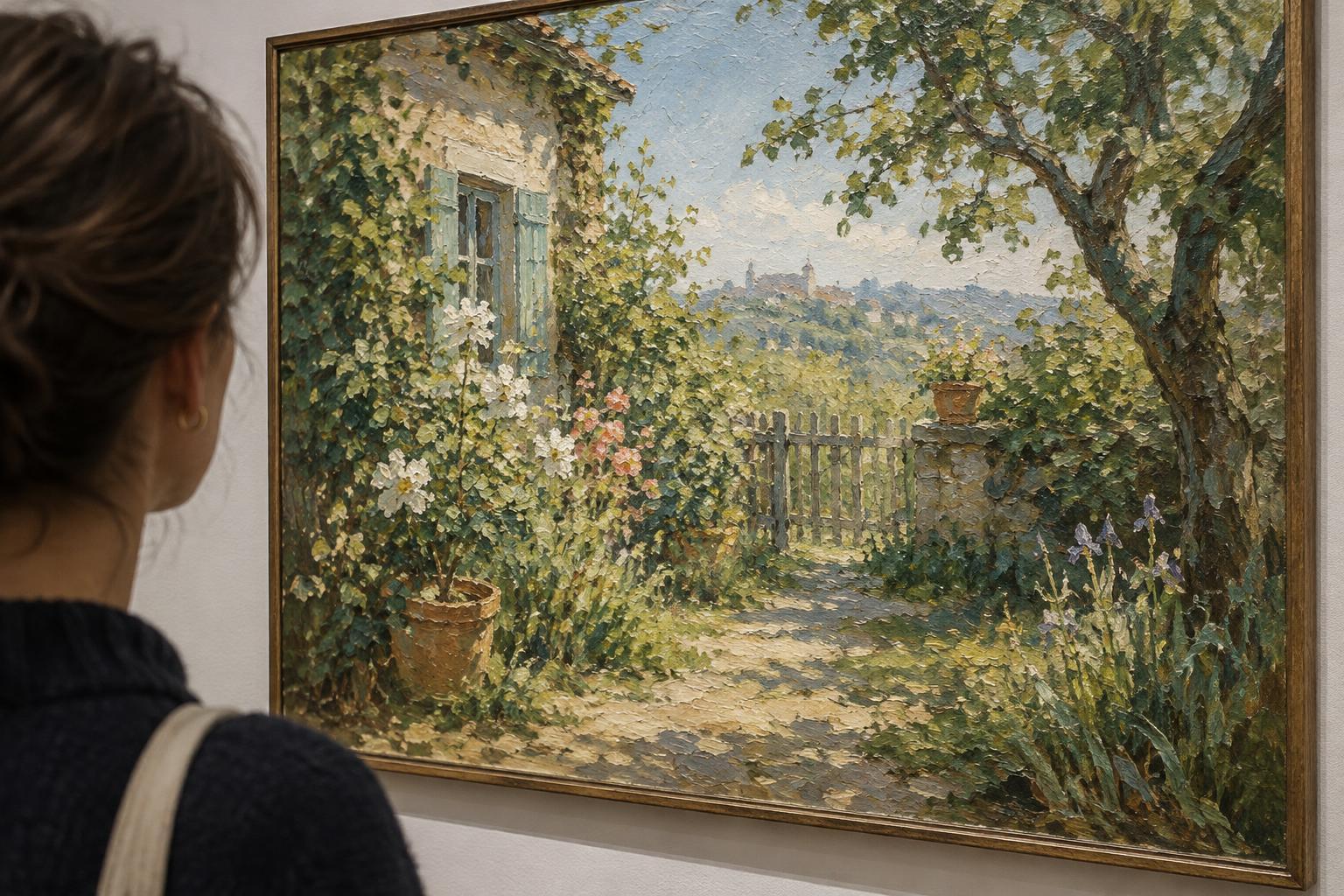
Then look more closely, staying at a comfortable distance and following any rules about where to stand. Shift your attention between one small area and the full composition. A patch that reads as a face, leaf or cloud from afar may become a collection of separate strokes up close. Neither view is more correct: the change between them is part of what makes brushwork interesting.
Look for direction, size and rhythm
Pick one area and ask which way the marks travel. Long strokes might follow the curve of a shoulder or pull your gaze across a landscape. Short, repeated touches can create a flickering or textured effect. Notice whether the marks are similar in size or vary sharply. A group of small strokes beside a broad, uninterrupted passage often makes both areas feel more distinct.
Try tracing the painting’s visual rhythm without touching it. Where do marks gather, overlap or change direction? Where do they become sparse? Brushwork can help suggest movement, but it can also guide attention through a still scene. You do not need to know which tool made every mark. A mark that looks like a brushstroke might have been altered with a palette knife, cloth or another tool, so begin with what you can actually see.
Notice edges and the weight of paint
Edges offer another useful clue. Compare the boundary between two shapes: is it crisp, blurred, broken or partly lost? A sharp edge can make a form stand out, while a soft one may let it blend into its surroundings. Look for places where paint crosses a boundary you expected to be neat. Such moments can make a painting feel lively or keep the eye moving rather than settling on a fixed outline.
Next, consider the surface. Some paint sits in raised ridges that catch the light; this noticeable thickness is often called impasto. Other passages look thin and flat, allowing a lower layer or the surface beneath to show through. A smooth appearance does not mean no deliberate work took place. It may reflect careful blending, thin layers or a choice to make individual strokes less visible. Changes in thickness can give a painting variety even when its colours remain restrained.
See how layers work together
Look for one colour peeking through another, or for marks that seem to sit on top of an earlier passage. A lighter stroke over a darker area might bring forward a highlight. A thin, transparent-looking layer may alter the colour beneath without hiding it completely. You may not be able to determine the exact order in which everything was painted, but visible overlaps can help you understand how the image has been built.
It is tempting to read every energetic stroke as evidence that the artist worked quickly. Appearance alone cannot tell you how long a passage took. A loose-looking mark may be carefully placed, and a smooth area may require many decisions. Describe the effect first—such as “the strokes feel brisk” or “the surface looks quiet”—without treating it as proof of the artist’s speed or state of mind.
Make looking a small, repeatable practice
Choose one painting and spend a few minutes comparing three areas: the focal point, the background and a place where they meet. Ask what changes in mark size, edge sharpness, direction or paint thickness. Then step back again. Do those differences help certain forms come forward, or do they make the whole surface feel equally active? There is no need to find a single hidden meaning; the aim is to connect what you notice close up with what you experience from a distance.
If you are looking at an image on a screen or in a book, the same questions still help, but treat apparent texture with care. Lighting, printing, cropping and image resolution can change how a surface appears. When you have the chance to see a painting in person, compare your impressions. Over time, this simple back-and-forth between the whole image and its individual marks can make even familiar paintings feel newly worth looking at.