Begin with what is in front of you
An unfamiliar artwork can make you feel that you are missing a key fact. You may wonder what it represents, why it was made or what you are supposed to think. Set those questions aside for a moment. Start with a simple inventory of what you can see: shapes, colours, figures, objects, marks, empty areas or changes in light. If the work is three-dimensional, notice its scale and the space around it.
Try describing the work without naming a style or assigning a meaning. You might say, “A small red shape sits near the edge,” or “The surface looks smooth from here but uneven up close.” This is not a test of accuracy. It is a way to slow down and give your attention somewhere to land. Notice, too, what you cannot tell from your position; moving a little closer or farther away may change what becomes visible.
Follow your attention
Ask yourself where your eye went first. Was it drawn by a bright colour, a face, a sharp contrast or an unusually quiet area? Then trace where it goes next. An artist may use lines, repeated forms, changes in size or the direction of a figure’s gaze to guide attention. You do not need to know whether every effect was intended to notice that it happens.
Look at the relationship between parts rather than treating each detail separately. Does one form seem crowded by another? Is the composition balanced, or does it feel as though it could tip? A large area of empty space can feel restful in one work and tense in another. If your first impression changes as you look, that change is worth noticing. It tells you something about how the work unfolds for you over time.
Consider the choices you can see
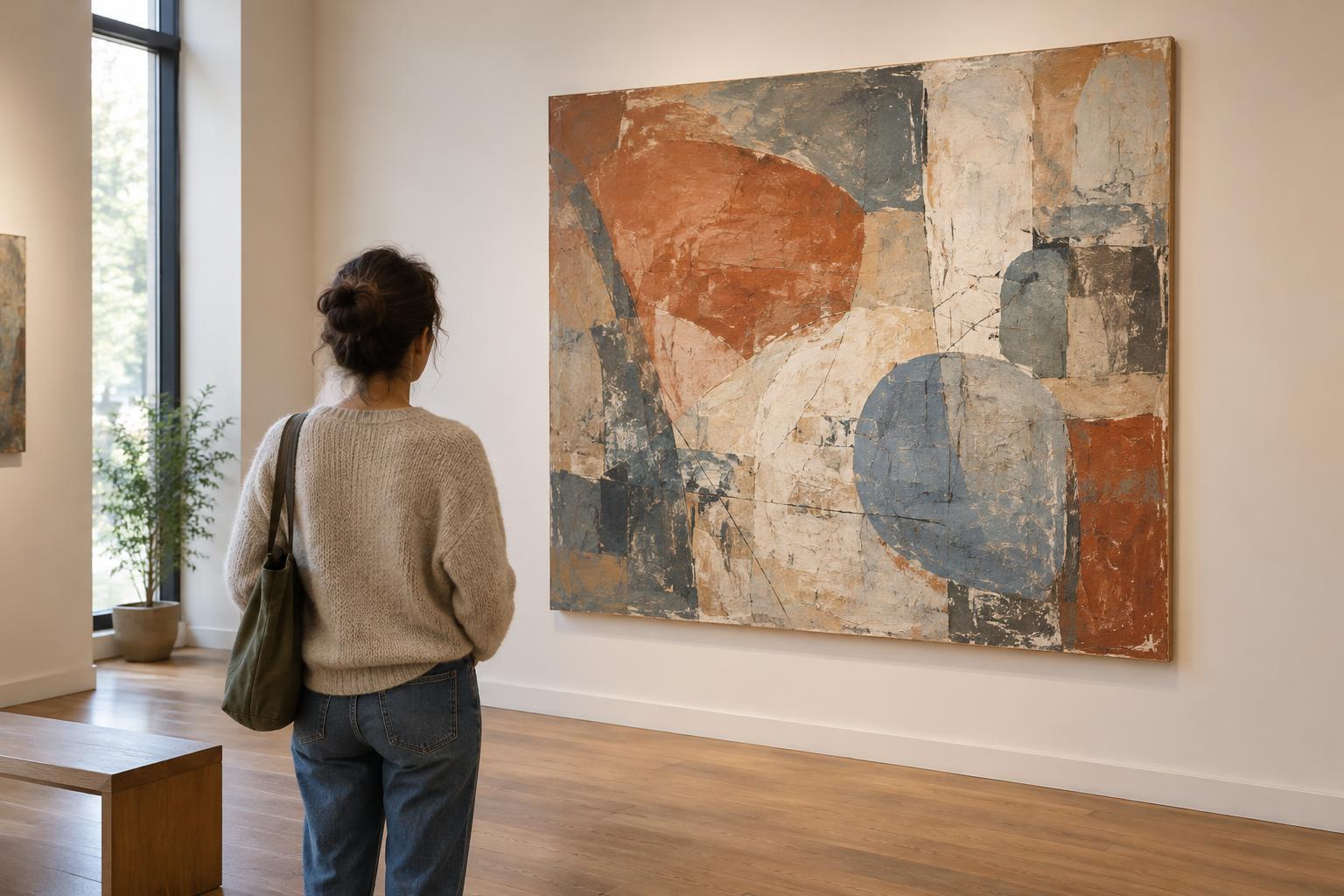
Materials and methods shape what an artwork can do. A thin wash of paint may let earlier marks show through, while thick paint may catch light and reveal the movement of a brush or tool. In a drawing, a dense patch of marks can carry a different weight from a faint line. With a photograph, consider framing: what has been included, and what lies just beyond the edge?
You can ask these questions even when you cannot identify the exact material or technique. What looks careful, repeated, rough, layered or deliberately left unfinished? Does the scale invite you to step back or lean in? If viewing conditions allow, try both distances. Avoid touching the work unless you have been invited to do so. The aim is not to reverse-engineer the artist’s process, but to notice how visible choices affect your experience.
Make room for your response without making it the whole story
An artwork may bring up a memory, a mood or a question you cannot immediately explain. That response is a useful starting point, not a wrong answer and not necessarily the work’s only meaning. Try connecting your reaction to something observable. Instead of stopping at “This feels unsettling,” ask whether the feeling comes from a cramped space, an ambiguous expression, an unexpected colour or something else.
It is also fine to feel little at first. Interest can grow from a modest question, such as why one corner is darker or why two similar shapes are not quite alike. If you are looking with someone else, compare what each of you noticed before debating interpretations. Different viewers may attend to different details, and neither needs to settle the artwork for the other.
Use context as an invitation, not a verdict
After spending some time looking, a title, label or conversation can open another route into the work. A title might name a place, suggest a mood or complicate what you thought you saw. Information about the artist’s materials or circumstances may help you recognize a choice you missed. It may also leave some of your questions unanswered.
You do not have to choose between your own observations and an explanation offered by someone else. Hold them together and see where they meet or differ. Before you move on, try finishing two sentences for yourself: “I noticed…” and “I wonder…” They give you a way to leave the work with a specific observation and an open question, even if you never arrive at a final interpretation.