Start with what you can see
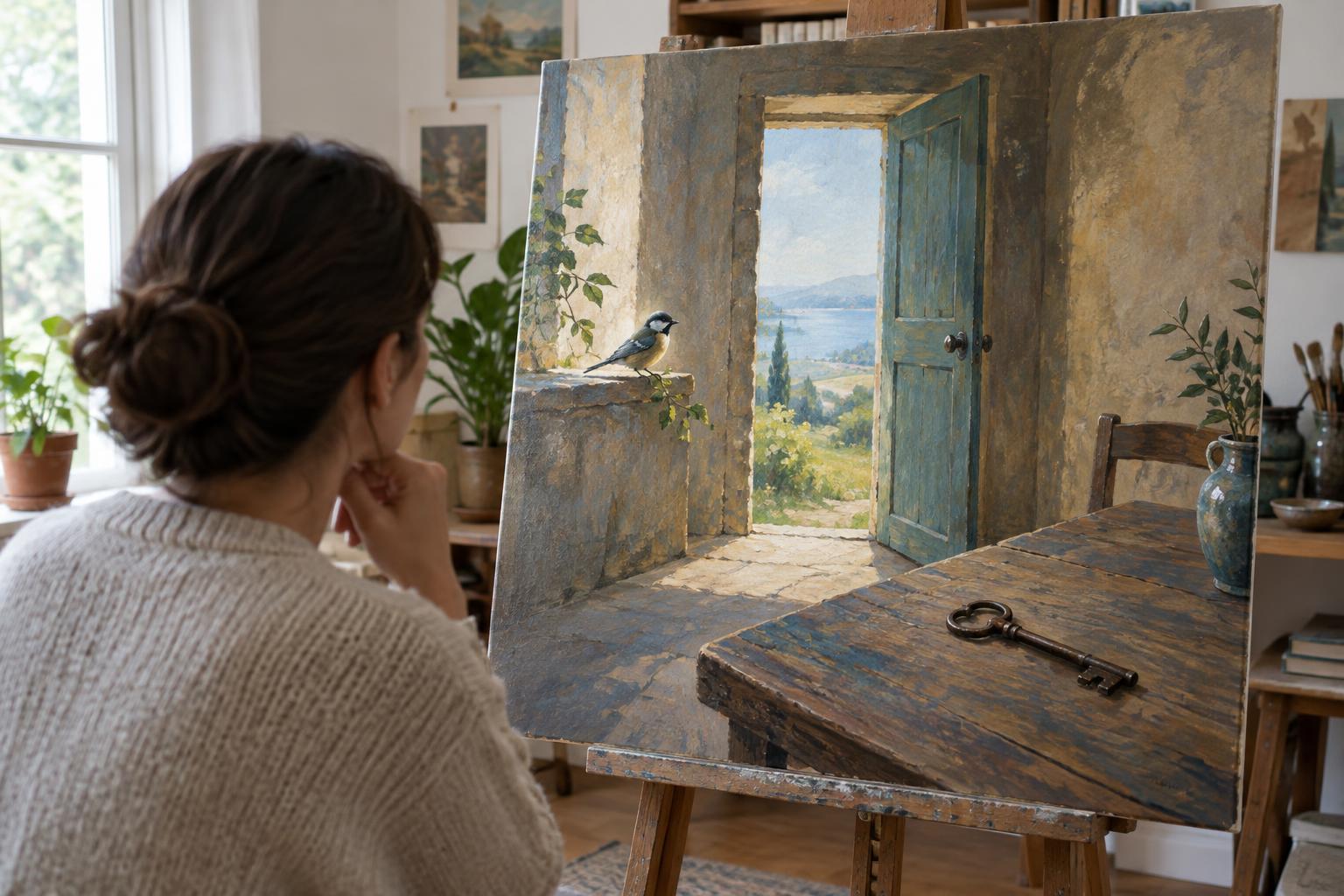
A symbol is an image, object, color, or gesture that may carry meaning beyond its immediate appearance. A painted key might suggest access, secrecy, responsibility, or simply a key used in the scene. The first step is not to choose among those possibilities. It is to describe what is there: the key’s size, position, color, and relationship to the figures and objects around it.
Look at how the artist directs your attention. Is the object brightly lit, repeated, held by a figure, or tucked into a corner? Does it feel out of place? Such details can make an element seem significant, although prominence alone does not prove it has a hidden meaning. Close observation gives you something concrete to return to when an interpretation begins to feel too certain.
Let the artwork shape the possibilities
The same object can work differently from one artwork to another. An open door in a quiet domestic scene might suggest welcome or departure; in a crowded, uneasy scene, it might feel like an escape route. Composition matters too. A door at the edge of a picture can invite your eye beyond the frame, while one blocked by a figure may call attention to a limit.
Consider the artwork’s mood, materials, and other visual choices before assigning meaning to a single detail. A carefully rendered flower in a still life may prompt questions different from those raised by a roughly painted flower on a wall. Ask, “What does this reading help me notice elsewhere in the work?” A useful interpretation connects details rather than isolating one object from everything around it.
Use context as a guide, not a shortcut
If information about an artwork is available, its title, medium, place of making, and the artist’s own comments can help you understand what you are seeing. An object may also have associations within a particular tradition or community. Those associations are worth learning about, especially when the artwork comes from a context unfamiliar to you.
Context does not always settle the matter. Titles can be suggestive rather than explanatory, and artists may leave room for viewers to respond in different ways. Be cautious with universal claims such as “birds always mean freedom.” A bird’s species, setting, and treatment may matter, and its associations can vary across cultures and individuals. If you do not know an object’s cultural significance, treat your first impression as a question rather than a fact.
Separate evidence, association, and speculation
It helps to name the kind of claim you are making. “There are three clocks in the painting” is an observation. “The repeated clocks make me think about time passing” is an association supported by that observation. “The artist intended to express regret” is a claim about intention that needs more evidence. None of these sentences is automatically useless, but they carry different levels of certainty.
Try framing an interpretation with words such as “might,” “could,” or “suggests” when the evidence is open-ended. Then test another possibility. Could the clocks establish the setting, create a visual rhythm, or introduce humor? You need not list every conceivable meaning. Comparing a few plausible readings can show which details each one explains and where your own assumptions begin.
Make room for your own response
Personal experience is part of looking at art. Someone who associates a garden with comfort may respond differently from someone who remembers difficult work there. These responses can deepen an encounter with an artwork, even when they do not tell you what the artist intended. Noticing the difference between “this reminds me of” and “this represents” lets you value your response without presenting it as the only possible reading.
For a simple exercise, spend a few minutes with one artwork and choose an element that catches your eye. Write down three things you can observe about it, two meanings it might suggest, and one question you would like to investigate. Return to the whole image before deciding which reading feels most convincing. The goal is not to solve the artwork like a puzzle. It is to look more attentively and leave room for meanings that may change as you learn.