Start with the person looking at the art
When hanging one artwork, begin with where people will view it rather than the empty wall. Stand where you would naturally pause to look. In a hallway, that might be a few steps back; beside a sofa, it might be the seat itself. The aim is to make the work easy to take in without noticeably lifting or lowering your head.
For a wall usually viewed while standing, placing the center of the artwork around standing eye level is a useful starting point. It is not a rule to follow at the expense of the room. People vary in height, and a piece seen mainly from a chair may feel more comfortable lower down. If the artwork has a small detail you want to see closely, check that you can approach it without having to crouch or stretch.
Treat the frame as part of the artwork
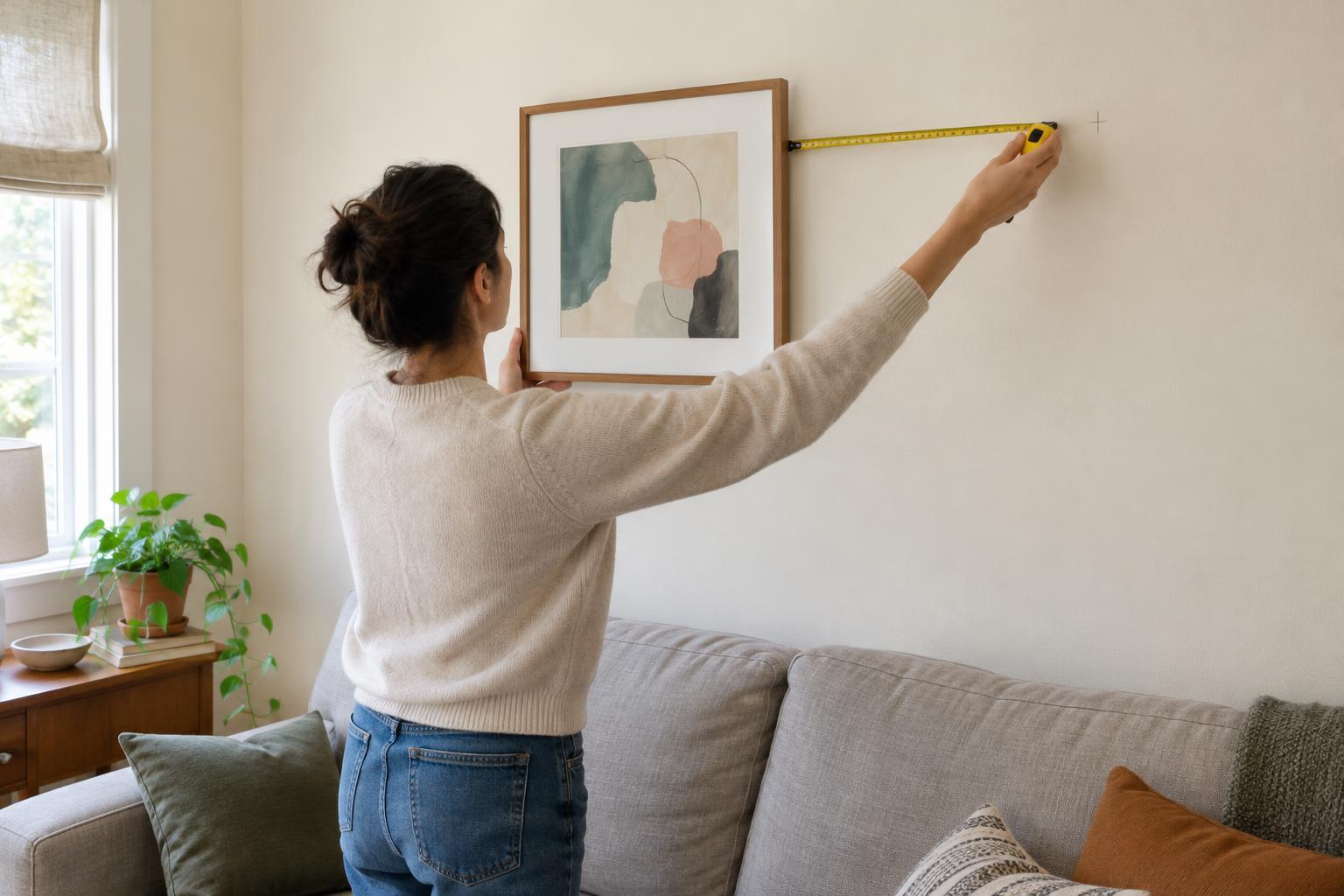
Use the full framed size when judging placement, not just the image inside it. A wide mat or substantial frame changes the visual center of the object on the wall. For a straightforward first position, measure the frame from top to bottom and mark its midpoint lightly on a piece of removable tape placed on the wall.
Then step back. A tall, narrow work may look balanced with its center at your chosen viewing height, while an image concentrated near the top of a large mat may seem to sit higher. You can adjust by eye after establishing a starting point. It is easier to make that judgment with a paper template cut to the frame’s outer dimensions than with the artwork held in your hands.
Let nearby furniture guide the position
An artwork above a sofa, desk, or sideboard is usually read together with the furniture beneath it. If you place it solely according to standing eye level, it may appear disconnected from that arrangement. Try holding the template at a height where the artwork and furniture feel like one group, leaving enough open wall that neither looks crowded.
Check the view from the places people actually use. Sit on the sofa, pull out the desk chair, or walk through the doorway. Make sure the work is visible without competing awkwardly with a lamp, shelf, or open door. Above furniture, also consider everyday movement: the bottom edge should be clear of heads, objects being moved, and hands reaching across the surface.
Measure the fixing point, not just the frame position
Once the proposed position feels right, mark the frame’s top edge on removable tape. Next, inspect the hardware on its back. The wall fixing rarely lines up with the top of the frame: it must meet the hook, D-ring, or hanging wire at the point that will carry the weight. Measure down from the frame’s top edge to that point, then transfer the distance to the wall.
For a wire, pull it upward as it will sit when hung before taking the measurement. A slack wire can make the finished artwork hang lower than expected. Check that the fixing and wall are suitable for the artwork’s weight, and use appropriate hardware rather than assuming a small nail will hold every frame. If you are unsure about a heavy piece or an unfamiliar wall, seek help before drilling.
Make a final check before committing
Tape the paper template in place and live with it briefly if you can. Look from the main entrance to the room and from your usual viewing spot. Notice whether the artwork feels too high, too close to furniture, or lost in a large area of wall. Small adjustments often matter more than finding a supposedly perfect measurement.
After hanging, check that the frame sits level and does not shift easily when a door closes or someone passes. Finally, look at it in the room’s usual light. A comfortable viewing height lets you enjoy the work naturally; the best placement is the one that fits both the artwork and the way you use the space.