Start with what catches your eye
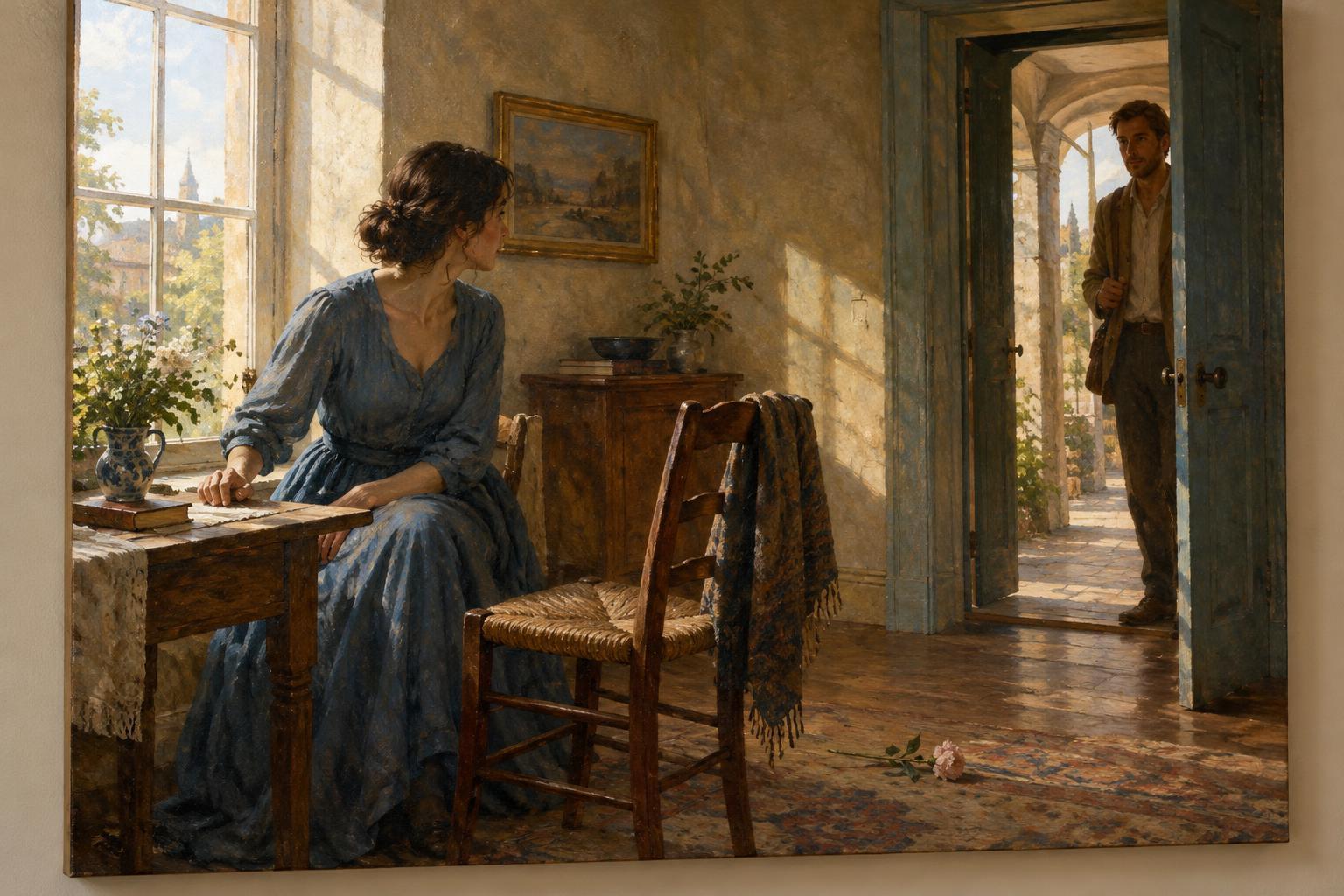
A painting does not need a sequence of scenes to suggest a story. One image can show a moment that seems to have a before and an after: a person paused at a doorway, a table set for someone absent, or a boat nearing shore. The story may remain open, but the painting offers clues about where to begin.
Look at the work for a few moments before trying to explain it. What did you notice first? It might be a face, a bright patch of colour, an unusual object or an empty space. Then ask what brought your attention there. Contrast, size, sharp edges and placement can all make one part of a painting stand out. Your first impression is not the whole story, but it gives you a starting point for exploring it.
Follow the route your eyes take
Once you have found a starting point, notice where your gaze travels next. A figure may look toward another person. An outstretched arm may point to an object. A road, railing or line of light may lead deeper into the scene. These connections can help you follow the image even when nothing is literally moving.
Pay attention to where your gaze slows down or circles back. A small detail near the edge might change how you understand the central action. An open door can connect an interior to a world beyond it; a dark corner can hold something you cannot quite identify. There is no requirement to view every part in a fixed order. Try describing your route through the painting, then look again to see whether you find another.
Look for relationships, not just objects
A visual story often lies in the relationships between things. Two figures standing close together might seem companionable, tense or simply crowded, depending on their gestures and expressions. Someone turned away from a group may appear separate from it. An untouched cup beside a seated figure could suggest another person, though it does not prove one was there.
Ask a few simple questions: Who or what appears connected? Where is there distance? What seems to be the focus of someone’s attention? Then compare possible answers with what you can see. A raised hand might be a greeting, a warning or part of an ordinary task. Keeping more than one possibility in mind helps you notice clues without forcing the painting into a plot it may not support.
Notice how the painting shapes time and mood
Although the image is still, its composition can make a moment feel brief or drawn out. A figure caught mid-step may suggest an action in progress. A carefully arranged room with no people in it may invite you to wonder who has left or who might arrive. You can ask, “What might have happened just before this?” and “What might happen next?” Treat your answers as possibilities rather than facts.
Colour, light and brushwork also affect how a scene feels. Soft transitions may give a place a quiet quality, while strong contrasts can make parts of it feel urgent or exposed. Loose marks may leave details unresolved; precise ones may draw you toward a particular object. These choices do not have one automatic meaning. Consider how they work alongside the figures, setting and objects in this painting.
Build an interpretation you can revisit
After looking closely, try putting the painting’s story into one or two sentences. Begin with what you can observe: “A person stands apart from the others and looks toward an open doorway.” Then add a tentative interpretation: “The scene could suggest a decision or a departure.” Separating observation from interpretation makes it easier to see where your ideas come from.
Finally, look for something that challenges your first reading. Perhaps the figure’s posture seems more relaxed than you initially thought, or an object you overlooked connects them to the group. You do not have to solve the painting. Following its visual story means paying attention to the paths it offers, testing your ideas against its details and allowing an unresolved moment to remain interesting.