What the letters and numbers mean
A graphite pencil contains a core made from graphite and clay. The balance of those materials helps determine how the pencil feels and how much graphite it leaves on the page. Grades marked H are harder and generally make lighter marks. Grades marked B are softer and generally make darker marks. HB sits near the middle, while F is another relatively firm grade often used for precise writing or drawing.
A number tells you how far a pencil sits from the middle of its range: 2H is harder than H, and 4B is softer than 2B. You do not need a full box of grades to begin. Grade labels are useful guides, but pencils from different makers may feel or look slightly different. The paper and the way you draw matter just as much as the letter stamped on the barrel.
Match the grade to the mark you want
For a light layout, an H or 2H pencil can make lines that stay unobtrusive while you plan shapes and proportions. Use a gentle hand: a hard point pressed into paper can leave an indentation even when the mark itself looks pale. If you prefer to sketch with a freer, more visible line, HB or B may feel easier to control.
Softer grades such as 2B, 4B and 6B are useful when you want broad shadows, dark accents or expressive strokes. They deposit graphite readily, so they can reach a deeper tone without as much pressure. The trade-off is that their points wear down faster and their marks are easier to smear. A firm pencil can be helpful for small details, but a carefully sharpened B pencil can draw a fine line too. Hardness affects the experience; it does not dictate what you are allowed to draw.
Choose a small working set
A practical starting set is 2H, HB, 2B and 4B. The 2H can handle light planning lines; HB can establish edges and midtones; 2B can build shadows; and 4B can add the darkest areas. If you rarely make preliminary outlines, you might replace 2H with H or simply begin with HB. If your drawings depend on very dark passages, you may enjoy adding a 6B.
Think of these pencils as overlapping tools rather than four fixed jobs. You can create many tones with one grade by changing pressure, spacing and the number of layers. Keeping a few grades nearby mainly makes it easier to move between delicate marks and dark ones without forcing a single pencil to do everything. Start with the marks you actually use, then add a grade only when you notice a recurring need.
Let the paper influence your choice
On smooth paper, a harder pencil can produce crisp lines and controlled hatching, while a soft pencil may glide over the surface and build an even tone. Textured paper catches graphite on its raised areas, making the grain visible. That broken texture can bring life to a sketch, though it may make a perfectly even shadow harder to achieve. Try the pencil on the same paper you plan to use for the drawing.
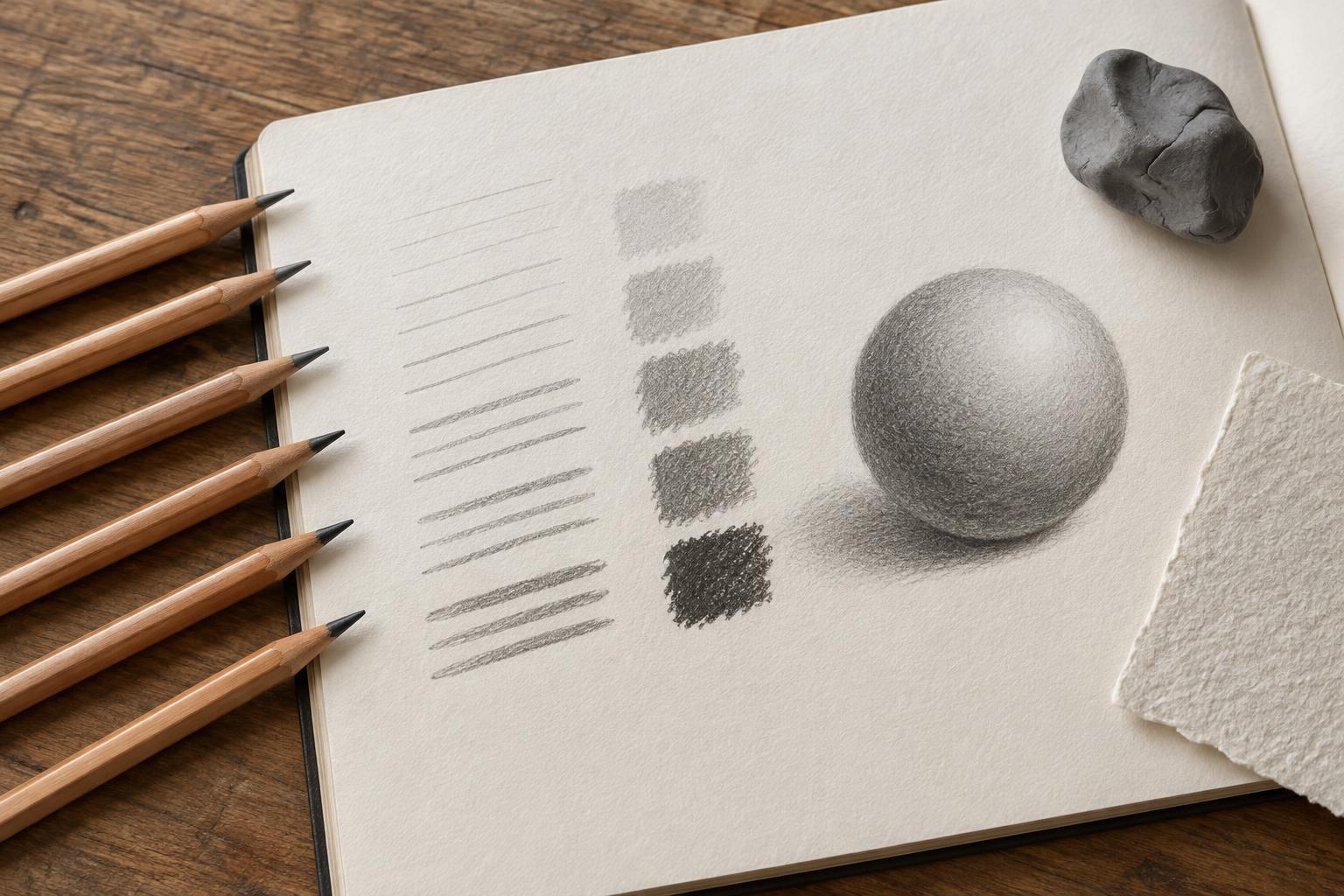
Before starting, draw a short line and a small shaded patch with each grade. Make one patch with light pressure and another with several gentle layers. Compare how dark they become, how easily you can see the paper texture, and whether the graphite smudges when your hand passes nearby. This quick test is more useful than choosing a grade by its label alone. It also shows you how your own drawing pressure changes the result.
Build tone without fighting the pencil
For a shaded drawing, begin with light marks and develop the values gradually. Use HB or 2B to establish the main midtones, then bring in a softer pencil where the darkest shadows belong. Work from broad shapes toward smaller details so a dark line does not become an accidental outline around every form. Leaving some paper untouched can preserve bright highlights more cleanly than trying to erase a heavily worked area later.
Keep a spare sheet under your drawing hand if smudging becomes distracting, and sharpen when you need a clean edge rather than pressing harder to compensate for a blunt point. If a soft grade looks shiny in a dark patch, additional pressure may make it shinier without improving the drawing. Step back, compare the light and dark shapes, and decide whether a change in value is needed at all. The right pencil is the one that helps you make the mark you intended on the surface in front of you.