What a two-minute drawing is for
Gesture drawing is a quick study of what a pose is doing rather than a careful record of what every part looks like. In two minutes, you can suggest a figure reaching, leaning or resting without drawing a finished outline. The goal is to make the pose readable through a few relationships: the direction of the torso, the placement of the limbs and the way the body carries its weight.
A short time limit can be useful because it asks you to choose. You cannot describe every finger or fold of clothing, so you look for the larger action first. A lively gesture may have awkward proportions, and that is fine. If someone else could sense the pose from your marks, the drawing has done its job.
Set up for quick, uninterrupted looking
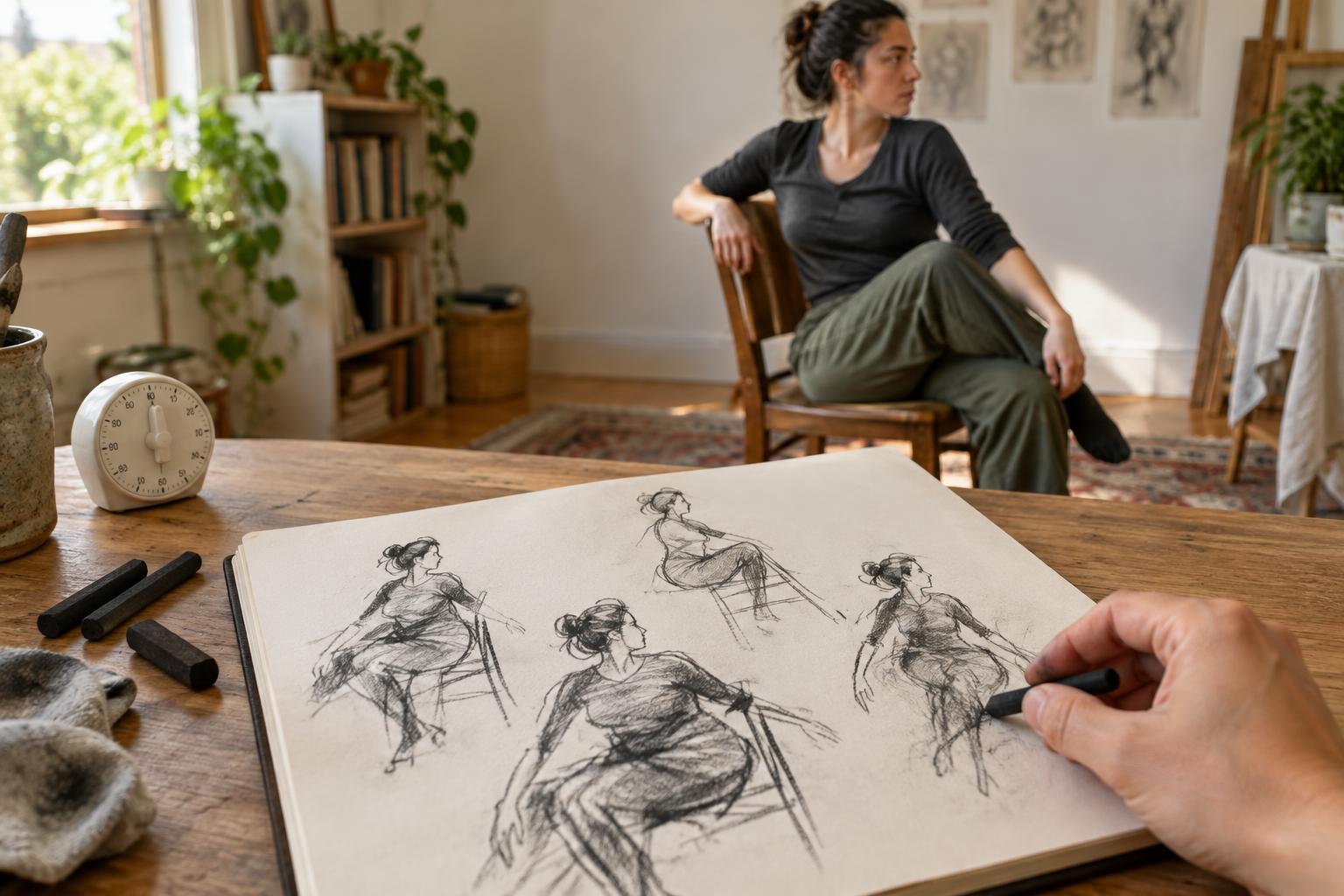
Use a pencil, pen, charcoal or any tool that lets you make marks without fuss. Keep several sheets of paper nearby, or divide a page into generous spaces for separate studies. A timer helps, but it need not be exact to the second. Choose a person willing to hold a comfortable pose, or work from a still reference image. Avoid asking anyone to maintain a strained position for the sake of a drawing.
Before starting, spend a moment looking at the whole figure. Notice where the head sits in relation to the feet and whether the pose feels upright, curved, compressed or extended. You do not need to name every body part. This brief pause gives you a starting idea so that the first mark responds to the pose rather than to the edge of the page.
Build the pose from action to mass
In the first few seconds, draw a line of action: a loose path that expresses the main sweep of the pose. It might run from the head through the torso toward a supporting leg, but it does not have to follow the spine exactly. Use the line to answer a simple question: which way is the figure moving or leaning? If the pose has no dramatic curve, a subtle tilt can still communicate its character.
Next, place simple shapes for the rib cage and pelvis. They can be ovals, boxes or quick angled marks; choose whichever helps you see their direction. Compare their tilts. A shoulder line slanting one way and a hip line slanting another can say more about a standing pose than a detailed face. Add limbs as paths between major joints, letting them bend or overlap where you see them.
With the time that remains, look for weight. Which foot, hand or seat supports the body? Does the torso settle over that point, or pull away from it? Reinforce the marks that explain the answer, and leave less useful marks light. You may add a few broad outer contours to give the shapes volume, but resist tracing the entire silhouette. An unbroken outline can make you concentrate on edges before you understand the action inside them.
Use the clock without drawing frantically
Think of the two minutes as three flexible passes: find the overall action, connect the large forms, then clarify what bears weight or creates the strongest bend. You do not need to check the timer between passes. If you find yourself drawing tiny features while the torso is still missing, step back and return to the whole figure. Make a mark because it explains the pose, not merely because you have found something else to draw.
Keep your eyes moving between the subject and the paper. Long periods spent polishing one area can make the rest of the pose drift out of place. When a line seems wrong, try another rather than repeatedly erasing. Several searching lines can show how you arrived at the movement, and they are often more useful for practice than one heavily corrected edge.
Learn from a small series of sketches
After a few poses, place the drawings side by side. Ask which one communicates a shift of weight most clearly, where a limb feels connected to the torso and where details distracted you from the larger action. This is more helpful than judging each sketch by how closely it resembles a polished figure drawing. You might discover that your simplest study captures the pose best.
For another round, give yourself one focus: the tilt of shoulders and hips, the space between the arms and torso, or the placement of the supporting foot. Repeating a pose from a new angle, when possible, can also help you see that gesture is about relationships rather than memorized shapes. Over time, the two-minute exercise becomes a way to look more attentively, not a test of how fast you can draw.