What contour drawing helps you notice
Contour drawing is a way of describing an object through its visible edges. An edge might be the outside boundary of a cup, the line where its handle meets the body, or the fold where a piece of fabric changes direction. Instead of starting with shading or trying to make a polished picture, you follow these boundaries with your eyes and let your hand respond.
The aim is not to prove that you can draw a perfect cup. It is to spend more time looking at the cup than thinking about the symbol of a cup you already know. A rim that appears oval, a handle that sits at an unexpected angle, and a slight change in the side’s curve can all become easier to notice when you give each edge your attention.
Set up a simple first practice
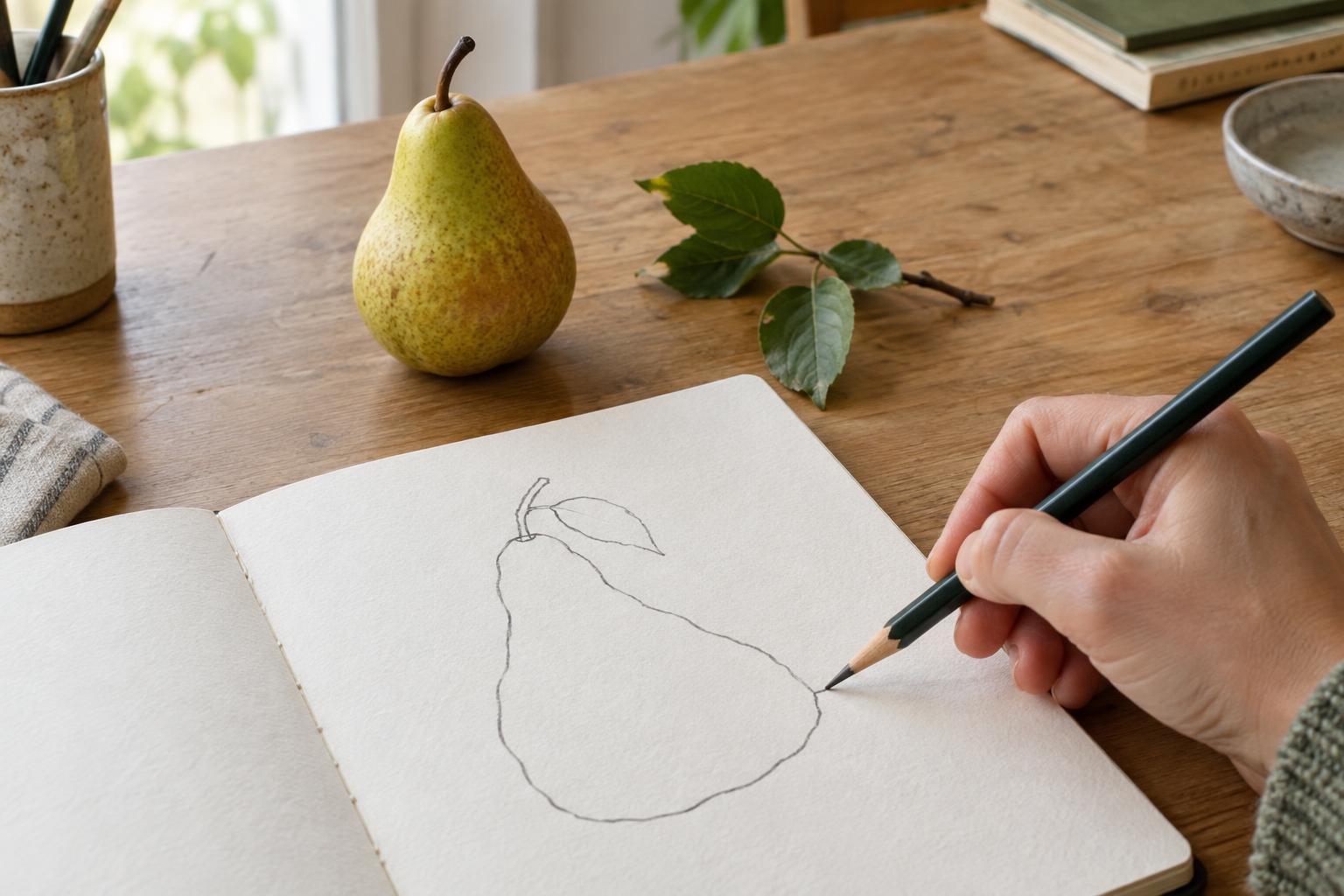
You need only paper, a pencil or pen, and one object that will stay still. A mug, houseplant leaf, shoe, or pair of scissors can work. Choose something with a few clear changes in direction, but not so many details that you feel obliged to draw every one. Place it where you can see both its overall shape and a few inner edges without moving it.
Sit comfortably and position your paper so your drawing hand can move freely. Before making a mark, look around the object’s boundary. Notice where an edge bends, disappears behind another part, or meets a different edge. Then choose a starting point. You do not need to plan the entire drawing; you need only decide which visible line to follow first.
Try blind contour drawing
In blind contour drawing, you look at the subject rather than at your paper while you draw. Rest your pencil on the page, place your eyes on one point of the object’s edge, and move both your gaze and your drawing hand slowly. Imagine your eyes traveling along the edge as your pencil travels across the paper. When the edge turns, let your line turn. If it dips inward or pauses at a corner, give that change time.
Keep the pencil in contact with the paper for this first attempt if you can, even when you move from an outer edge toward an inner one. The resulting line may overlap, wander, or fail to meet itself. That is normal for this exercise. Resist the urge to peek and correct it. Spend a few minutes on one drawing, then look at the page and identify a place where you noticed something specific about the object, even if the outline looks unusual.
Add control with modified contour
Modified contour drawing uses the same careful observation but allows occasional glances at the page. Start by following an edge with your eyes and pencil, then check where your hand is before continuing. These brief checks can help you place a handle beside a cup or connect a leaf vein to its outer shape. Try to keep looking at the subject far more often than at the drawing, so the checks support observation rather than replace it.
You can also lift your pencil when you reach the end of a visible edge. An object does not always have one uninterrupted outline: a line may vanish behind another form or become too faint to distinguish. Instead of inventing a connection, pause and choose the next edge you can actually see. This makes modified contour useful when you want a more readable drawing while still practicing close attention.
Build a habit of looking, not correcting
Try drawing the same object more than once. On one page, follow only its outside boundary. On another, include the edges inside the shape, such as seams, folds, or overlapping parts. You might also draw it from a different seat. These small changes give you fresh things to observe without requiring new materials or a complicated setup.
After each drawing, compare it with the object before reaching for an eraser. Ask where the line changed direction convincingly, which edge you rushed, and what you missed because you assumed you knew its shape. Accuracy can improve with practice, but it need not be the only measure of a useful session. If the exercise led you to see an ordinary object with greater care, your drawing has already done valuable work.