What makes a work conceptual?
In conceptual art, an idea or question plays a central role in the work. The visible result might be a photograph, a written instruction, a collection of ordinary objects or almost nothing to look at. This does not mean appearance is irrelevant. It means that what you see may be one part of a larger proposition: something the artist wants you to consider, test or notice.
Imagine an artist placing a neatly folded empty shopping bag on a plinth. On its own, it could seem like an ordinary bag in an unexpected location. Give the work the instruction “Take it whenever you need it,” and other possibilities emerge. Is the work the bag, the invitation, the decision to leave it alone or the change that happens if someone takes it? This is a hypothetical example, but it shows how an idea can shape what an object does in an artwork.
Look at what the work asks you to do
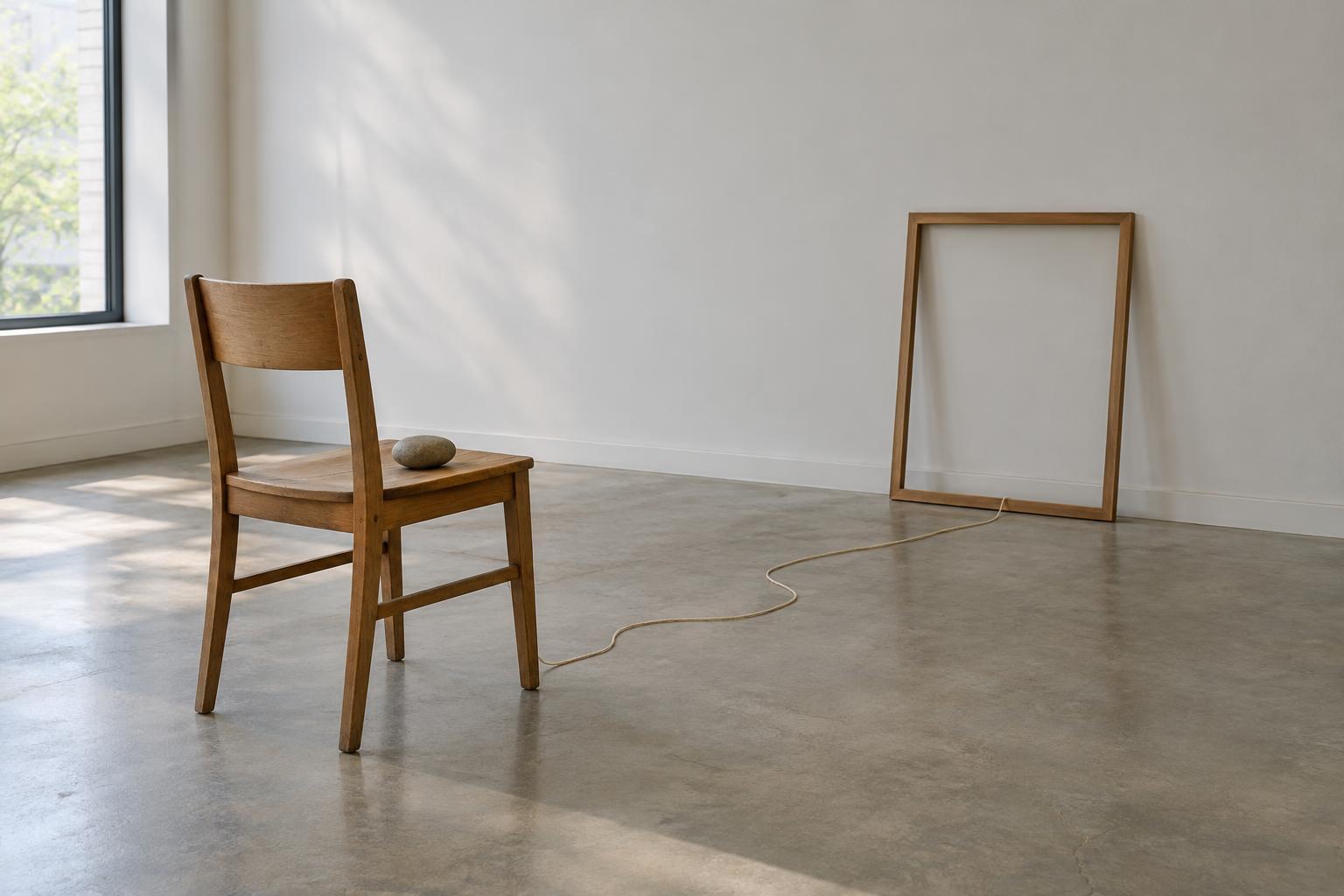
A useful first step is to describe the work before trying to decode it. What is physically present? Are there words, images, sounds or repeated objects? Is anything missing that you expected to find? Then notice your own position. Are you being asked to read, walk around, wait, participate or simply imagine an action? These observations give you a starting point without requiring an immediate interpretation.
Next, turn your observations into questions. Why might the artist have chosen these materials instead of others? What changes because the work is displayed here rather than somewhere else? If there are instructions, are they meant to be followed, considered or resisted? You do not have to answer every question. In idea-led work, the process of asking may be part of the experience.
Use context without treating it as a secret answer
A title, label or short description can clarify what an artist intended to set in motion. It may tell you that an object is a record of an earlier action, or that a set of images follows a particular rule. Reading that information is not cheating. Some works depend on details that cannot be seen in the finished display. If a label is available, try looking first, reading it and then looking again to see what has changed.
Context is helpful, but it need not settle your response. A title may suggest one theme while the materials suggest another. The work might also leave room for a viewer to disagree with its premise. Try distinguishing between what you can observe, what the artist has indicated and what you infer. That distinction lets you form a thoughtful reading without pretending there is only one correct answer.
Materials and presentation still matter
It is easy to hear “the idea is central” and assume that craftsmanship or visual choices do not count. Yet the form can change how an idea reaches you. A sentence printed on a wall feels different from the same sentence whispered by a participant. A stack of identical sheets invites a different response from a single sheet kept behind glass. Scale, repetition, placement and access can all contribute to meaning.
Sometimes the work is temporary, so you encounter a photograph, a diagram or another form of documentation instead. Ask what that record allows you to understand and what it cannot convey. A photograph may show how an action looked without showing how long it took or what it felt like to be there. The record can be worth examining in its own right, while still pointing toward something beyond the image.
Finding your own way in
If a work leaves you unmoved, that is a valid place to begin. Rather than asking whether you are supposed to like it, ask what choice the artist made that you find interesting, irritating or unnecessary. Could the same idea have been communicated more clearly? Does the work make you pay attention to something you usually overlook? A considered disagreement can be more useful than forcing admiration.
You can try this approach with art you encounter in a gallery, in a book or in a public space. Spend a moment describing what is there, identify a decision that seems deliberate and pose one question about it. You may leave with an interpretation, several possibilities or no firm answer. Understanding conceptual art does not require solving every work. It starts with noticing how an idea becomes an experience.