What the label tells you—and what it does not
The main difference between alcohol-based and water-based markers is the liquid that carries their color onto a surface. Alcohol-based ink usually dries quickly and can be layered with relatively smooth transitions. Water-based ink uses water as its main carrier and often behaves more like a familiar drawing pen, though formulas vary widely. Neither label guarantees a particular color strength, nib quality or lifespan.
It helps to think beyond which type is “better.” A marker for filling broad areas in an illustration has a different job from one used to add small details to a sketchbook page. Your preferred marks, paper and working pace matter as much as the ink. If possible, test a few strokes, a filled shape and an overlapping layer before committing to a larger set.
Blending, layering and the look of the line
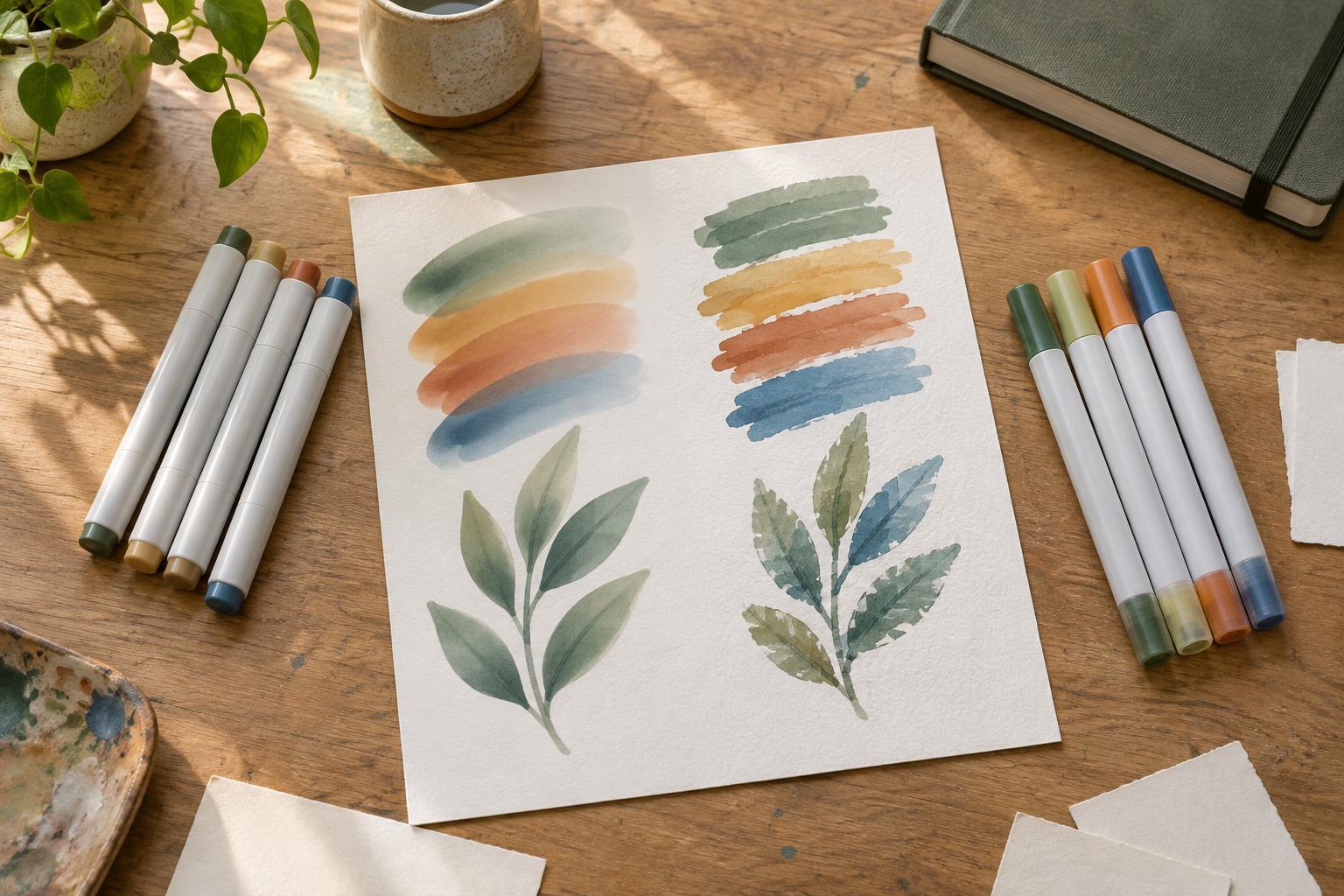
Alcohol-based markers are popular for smooth color fields, gradients and shaded forms. While an area remains workable, you can often soften an edge by passing over it with another shade or repeating a stroke. This makes them useful for illustrations that rely on gradual changes in value. They can also spread beyond the exact path of the nib, especially on absorbent paper, so a small margin inside your outline may help.
Water-based markers often give you more control over a crisp line and can suit lettering, pattern work or drawings built from distinct patches of color. Some can be blended with a damp brush, but others become streaky or disturb an earlier layer when rewetted. Repeated passes may roughen paper or create darker overlap marks. Those effects are not necessarily flaws: visible strokes can add rhythm and texture to a drawing.
Color permanence is a separate question. A water-based marker is not automatically less lasting, and an alcohol-based marker is not automatically archival. If a finished piece will be displayed, check the manufacturer’s information about lightfastness and consider keeping an important original away from strong light.
Paper can change the result
Marker choice is also paper choice. Alcohol-based ink can soak through ordinary sketchbook sheets and mark the page underneath. Smooth paper made for markers can reduce unwanted spreading and help preserve a clean edge, although some bleed-through may still occur. Put a spare sheet beneath your work when testing a new combination.
Water-based markers may sit neatly on smooth drawing paper, while heavier paper can be helpful if you plan to add water with a brush. Very absorbent paper may feather a line; delicate paper may pill after repeated wet strokes. Before starting a finished drawing, make a small test area with the marks you actually intend to use: a long stroke, two overlapping colors and several layers. Look at both sides of the sheet.
Everyday handling and practical costs
Water-based markers are often convenient for casual sketching because many formulas have relatively little odor and fresh marks may be easier to clean up with water. That does not make every ink washable from clothing or furniture, so protect your workspace. Alcohol-based markers can have a noticeable solvent smell; use them in a well-ventilated space and recap them promptly. Follow the product’s handling guidance, particularly when sharing materials with children.
Consider how you will maintain your supplies, not just their initial price. Some marker ranges offer replacement nibs, refill inks or individual colors, which may be useful if you repeatedly use the same shades. Other markers are intended to be replaced when dry. Storing either type capped and as directed by its maker helps avoid preventable waste.
Choosing a small set to start
Choose alcohol-based markers if your main goal is smooth shading across larger shapes and you are willing to use suitable paper and protect the surface beneath it. Choose water-based markers if you prefer defined strokes, portable line work or experiments with water-reactive color—after confirming that the particular markers you buy support that effect. For mixed-media work, test each marker alongside your pens, pencils and paint; layering order can change whether a line stays sharp.
You do not need a full spectrum to learn either medium. A light, middle and dark shade in one color family, plus a neutral, offer enough range to practice depth and contrast. Draw the same simple object with both types if you can: fill its silhouette, add a shadow and note where the edges stay crisp or soften. The most useful marker is the one whose behavior helps you make the marks you want.