Start with the mark you want to make
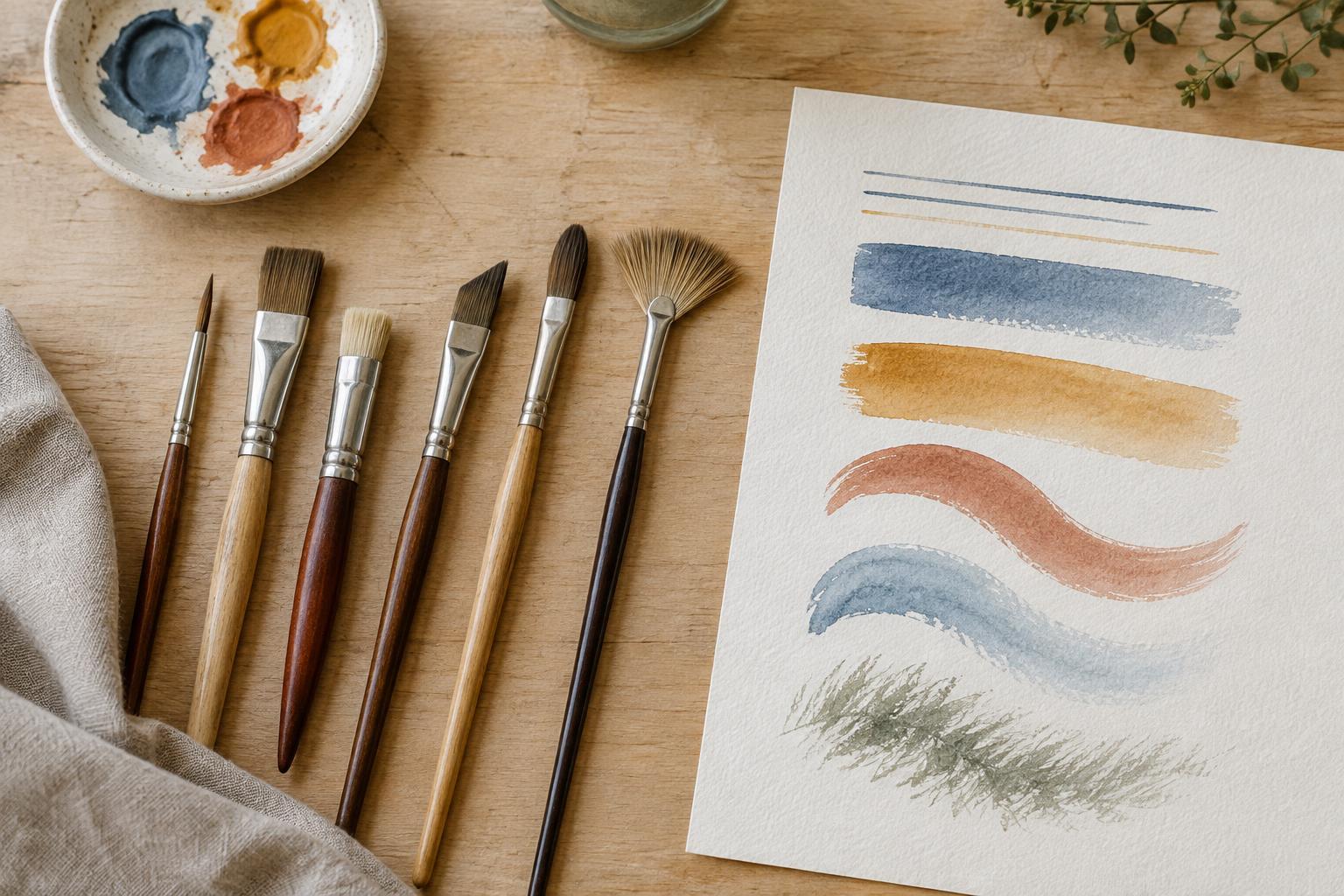
A brush’s shape affects how paint reaches the surface. A pointed brush can move from a fine line to a wider stroke as you change pressure; a broad, square-edged brush can cover an area quickly. Shapes are useful guides, but they do not have only one job. The paint’s thickness, the brush’s size, the surface and your hand all change the mark.
Brush sizes are not standardized across makers, so compare the width of the bristles rather than relying on a number alone. Before buying several shapes, consider what you enjoy painting. Large backgrounds, small details, soft-edged forms and straight architectural lines each ask for different kinds of control.
Round and pointed brushes: flexible tools for lines and details
A round brush has a rounded body that usually tapers to a point. With light pressure, its tip can draw a thin line or pick out a small detail. Pressing more of the bristles against the surface produces a broader stroke. This range makes a medium round brush a useful first choice, especially if you are still discovering how you like to paint.
For watercolor, a round brush that holds water and returns to a point can carry color across a small wash, then add finer marks. With acrylic or oil paint, a round can help place curved strokes or work into narrow spaces, though a heavily loaded brush may not keep a sharp point. A smaller round is handy for detail, but it will need refilling often if you use it to fill large areas.
Try drawing one continuous line while gradually increasing and releasing pressure. The exercise shows you more about a brush than its label does: notice whether the point stays together, how much paint it holds and how readily the bristles spring back.
Flat, bright and angled brushes: edges and coverage
A flat brush has a straight edge and relatively long bristles. Use its broad face to lay down bands of color or block in simple shapes. Turn it onto its narrow edge for a slimmer line. Flats are helpful when you want an edge to look deliberate rather than softly rounded.
A bright resembles a flat but has shorter bristles. Its compact head can give a firmer, more controlled stroke, particularly with thicker paint. An angled brush has bristles cut on a slant, making it convenient for corners, sloping edges and narrow spaces. You can use the long tip for a small mark or the full edge for a broader one.
These brushes are not shortcuts to perfectly straight lines. Move your whole hand steadily and keep an eye on how much paint sits on the bristles. A loaded edge may leave a thicker mark than you expect; a nearly dry edge may produce a broken, textured stroke.
Filbert and fan brushes: soft forms and texture
A filbert looks like a flat brush with a rounded end. It combines useful width with a less angular edge, making it comfortable for petals, clouds, rounded objects and softly turning forms. A single stroke can leave an oval-like mark, while overlapping strokes can build an area without the obvious square ends of a flat brush. For many beginners, a filbert is a versatile partner to a round.
A fan brush spreads its bristles in a wide arc. Lightly dragged over a surface, it can create broken marks or blend wet paint gently. It can suggest repeated textures, but the result depends strongly on pressure and paint consistency. Press too hard or work over the same spot repeatedly, and distinct marks may blur together.
Texture does not require a specialist brush. Testing the edge of a flat or the side of a round can reveal marks you might otherwise miss. Make a small sample sheet to compare strokes before adding them to a painting.
Choose a small set and care for it well
You do not need every shape to begin. A medium round, a wider flat and a medium filbert provide a practical range of lines, coverage and softer marks. Add a smaller brush when you regularly need detail, or an angled or fan brush when you know what you want it to do. Choose bristles suited to your paint: softer brushes are often useful for fluid paint, while more resilient bristles can help move thicker paint. Check the maker’s guidance if you are unsure.
Rinse brushes as you work, especially with fast-drying acrylic paint, and avoid leaving them standing on their tips. After painting, clean them with a method appropriate to the paint, gently reshape the bristles and let them dry without crushing the head. A modest set that you know well can be more useful than a large collection of unfamiliar brushes. The best way to learn each shape is to try it with your own paint and save the marks you like.